
B. Portfolio websites
Product Designer Portfolio Website: Show Process, Decisions, and Outcomes
Build a product designer portfolio website with case studies that explain the brief, constraints, research, design decisions and substantiated outcomes.
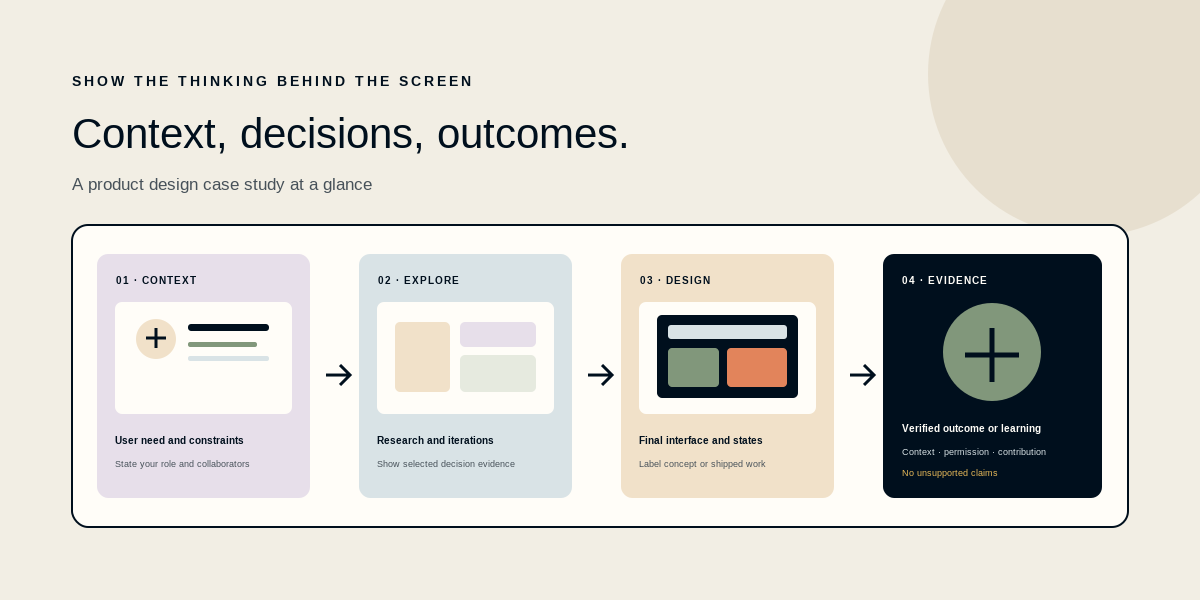
A product designer portfolio website should help someone understand how you approach a product problem, what you personally contributed and how your design decisions were made. A case study can show the brief, constraints, research, iterations and final interface without exposing confidential product details. Use outcomes only when they are verified and approved for publication; a clear account of the work is more credible than an unsupported success claim.
TL;DR
- Choose projects that show the kind of product design work you want to do next.
- Explain the brief, users, constraints and your role before showing design artifacts.
- Show selected iterations and decisions rather than uploading every project file.
- Use measurable outcomes only when the evidence and permission to share them exist.
- Make case studies readable, accessible and easy to connect with an enquiry or next step.
Decide what the portfolio needs to help someone judge
Start with the work you want to be considered for: product strategy, interaction design, research-led UX, service design or another defined practice. A hiring manager, potential client and collaborator may look for different signals, so make the portfolio's purpose and contact route clear. Choose a few projects that support that purpose rather than trying to represent every assignment equally.
- Describe the product or design problems you are prepared to work on.
- State the kinds of teams, industries or engagement models that are relevant to you.
- Choose projects that demonstrate different but related capabilities.
- Explain whether a project was shipped, prototyped, researched or still in progress.
- Make your preferred next step visible, such as discussing a project or viewing a resume.
Nielsen Norman Group's portfolio case study guidance emphasizes explaining the design and process behind a specific interface. Use that as a prompt to show relevant reasoning, not as a formula that every project must follow identically.
Structure a product design case study around the project
A case study should let a reader understand the assignment before interpreting the screens. Identify the user need, product context, constraints, stakeholders and your contribution. Then show the decisions and selected artifacts that explain how the work moved from a problem to an interface or service direction.
| Section | What to explain |
|---|---|
| Project summary | Product, team, timeframe and whether the work shipped, was tested or remained a concept. |
| Problem and context | The user or business need and constraints that shaped the work. |
| Your role | Responsibilities, collaborators and decisions you owned. |
| Research and exploration | Relevant methods, inputs and the questions they helped answer. |
| Iterations and decisions | Selected alternatives, trade-offs and reasons for the chosen direction. |
| Outcome and learning | Verified results, follow-up evidence or a clearly described unresolved question. |
Do not imply sole ownership when the work was collaborative. If a project used research conducted by another team, explain how you used those findings rather than presenting them as your own.
Show enough process to make design decisions understandable
A reader does not need every workshop note or screen. Select artifacts that show how you learned about the problem, considered alternatives and refined the interaction. A brief caption can explain what a sketch, flow or prototype demonstrates and why it matters to the final design.
- State the question or constraint that shaped the work.
- Show one or two artifacts that explain how you explored the problem.
- Describe a meaningful trade-off and the evidence considered.
- Connect the chosen direction to the task the interface supports.
- Show the final design in enough context to understand navigation and states.
- Name what you would validate next if the work continued.
If you cannot share a client screen, you can describe the decision at an approved level, redraw a generic flow, or use a clearly labeled self-initiated example. Do not publish confidential data, unreleased product details or screenshots without permission.
Describe outcomes without overstating the evidence
Use a metric only when you can explain where it came from, what changed and what part of the project the number represents. If measurement is unavailable, explain a verified qualitative outcome, a stakeholder decision or what the team learned. State clearly when a project was a proposal, prototype or concept instead of presenting it as a launched product.
| Statement type | Evidence to keep with it |
|---|---|
| Usage or conversion metric | Approved source, period, baseline and context for the change. |
| Research finding | Method, participant context and limits of the finding. |
| Delivery outcome | What shipped, who implemented it and the product scope. |
| Stakeholder decision | The decision made and the design work that informed it. |
| Concept or proposal | A direct label that the work was not a production release. |
Be careful with causal language. A business result can depend on engineering, marketing, pricing, product operations and other changes outside one designer's work. Describe the contribution accurately.
Make the portfolio accessible and easy to navigate
Use project titles that identify the work, headings that describe each case study and links that make the next destination clear. For interface screenshots and diagrams, provide useful text alternatives or a caption that explains the decision. Keep long case studies readable on phones and avoid placing important labels inside images without an equivalent text explanation.
- Group projects by the work or capability visitors need to evaluate.
- Keep project summaries concise and link to detailed case studies.
- Use image alternatives for informative screens and empty alternatives for purely decorative visuals.
- Check diagrams and prototypes at mobile width and enlarged text.
- Provide a direct contact path and state the kind of collaboration you are open to.
- Credit collaborators and confirm permission before publishing client work.
For a broader look at portfolio structures across creative disciplines, see the guide to portfolio website examples for independent creatives.
Keep the portfolio manageable as projects change
A portfolio becomes harder to maintain when it depends on a custom layout for every project. Use a consistent case study pattern, then allow a project to omit sections that do not apply. Review links, role descriptions, permissions and availability when a project or job-search goal changes.
- Choose a small set of representative projects for the first release.
- Create a reusable case study structure with optional evidence fields.
- Review sensitive details and image permissions before publication.
- Ask a peer to check whether your role and decisions are clear.
- Update project order and contact details when your target work changes.
Peak Web Craft's portfolio website development service supports selected project stories, galleries and enquiry paths within an agreed scope.
Frequently asked questions
What should a product designer portfolio website include?
Include a clear introduction, selected product design projects, case studies explaining your role and decisions, relevant artifacts, verified outcomes or learning, and a contact route that fits your goals.
What should a product design portfolio case study show?
Explain the project context, user need, constraints, your contribution, relevant research, iterations, design decisions and the status or outcome of the work.
How many projects should a product designer show?
Choose enough projects to demonstrate the work you want to be considered for, while keeping each case study clear and maintainable. A small, relevant selection is often easier to review than an uncurated archive.
Can I show confidential product work in my portfolio?
Only share material you are permitted to publish. You can seek approval, remove sensitive details, describe the decision at a high level or use a clearly labeled self-initiated example.
Should a product design portfolio include metrics?
Include metrics only when you can verify and explain the source, context and your contribution. If data is unavailable, describe a substantiated qualitative outcome or what the project established.