
01
Client and partner portals
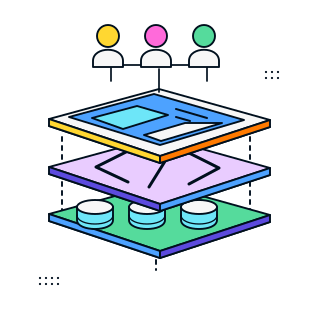
Give authorised users access to relevant records, requests or project information. Define what each role may view, edit and approve.
When your business needs more than pages and forms, start with the workflow. As a custom web application development company in Ahmedabad working with businesses across India, we plan and develop browser-based applications around the people using them, the information they handle and the rules that make the process work.
A custom web application is software accessed through a browser that performs tasks using business logic and data. It can support approvals, customer access, reporting or other operations rather than mainly presenting public information.
The right starting point is a specific problem: who needs to do what, with which data, and what happens when the normal path fails. That description is more useful than a list of desired screens.
Give authorised users access to relevant records, requests or project information. Define what each role may view, edit and approve.
Replace a clearly understood manual process with structured forms, records and state changes. Identify exceptions before automating decisions.
Present information that supports a real decision. Agree data sources, calculations, update frequency and export requirements.
Define a bounded first release that tests the essential product workflow. Tenancy, billing, onboarding and operational needs require explicit scope.
Connect supported systems where data needs to move between them. Specify ownership, error handling and what should happen when a dependency is unavailable.
Build the agreed tools for managing records, users or settings. Permission checks belong on the server as well as in the visible interface.
An established product may be the better fit when it already handles your workflow reliably. A custom application becomes more useful when the differences are material: unusual approval rules, specific data relationships, required integrations or a customer experience the existing tool cannot provide.
A booking website may be enough when scheduling is the main task. A business website is usually sufficient when visitors mainly need information and an enquiry form. We discuss those simpler options before committing to a larger system.
The proposal identifies the workflows, roles, screens, data model and integrations included in the release. We agree examples that demonstrate correct behaviour, including permissions, missing data and failed operations.
The handover covers the agreed source, configuration guidance, administrative controls and operating responsibilities. Hosting, external providers and licensed components retain their own terms; a custom build does not remove all dependencies.
Interactive interfaces may use JavaScript and an appropriate component framework, with server-side APIs and a database for business data. The choice depends on the current system, deployment needs, team maintenance and the actual operations being implemented.
Authentication identifies a user; authorisation decides what that user may do. We scope both, alongside input validation, data handling, backups and error reporting. Specialist security assessments or regulated-sector requirements need their own defined engagement.
A public product website, help content or approved catalogue may need search-friendly pages, metadata and internal links. Private dashboards, customer records and administrative routes need proper access control and appropriate indexing rules.
A robots instruction or noindex tag is not a security control. We separate public discovery content from authenticated operations and can scope SEO work for the public parts of the product.
Collect examples, user roles, data sources, pain points and exceptional cases.
Choose essential workflows and write reviewable acceptance criteria.
Plan data relationships, API boundaries and interface states before broad implementation.
Develop the agreed features and review real scenarios, including error and empty states.
Check permissions, integrations and release requirements; agree deployment, recovery and handover responsibilities.
Peak Web Craft is based in Ahmedabad and led by Nisarg Patel. We connect interface decisions with the underlying implementation and keep the scope tied to the business process. Share an example workflow or existing tool so the first discussion can focus on what must change.
Sensitive data, specialist integrations or unusual scale requirements are reviewed before delivery commitments. Ongoing support is defined around the application and responsibilities your team needs covered.
A discovery brief should identify users, records, actions, permissions, integrations and the situations that must be tested. Separate an essential first workflow from later improvements and explain who will operate the application.
An illustrative client-portal acceptance check is that one client can view only their own records, while an authorised staff member can review the assigned records. Changing a URL must not expose another client’s information. This is an example of a requirement, not a claim of a delivered portal.
A business website mainly communicates information. An application manages tasks and data using business rules, usually with more complex user states, permissions and operational requirements.
We can start with a code, dependency and workflow review. The findings determine whether focused changes are practical or whether parts of the system need replacement.
We can assess a defined initial release. The core workflow, user model, access rules and operational requirements must be clear; a prototype is not automatically a complete production platform.
We review its documentation, access requirements, supported operations and limits. The scope includes the expected failure behaviour and any data reconciliation needed.
The proposal defines source and deliverable ownership, access and handover. Third-party software, services and licences retain their own terms, which should be identified before implementation.
We assess workflow complexity, data, roles, integrations, testing and client dependencies. Discovery may be needed before a responsible delivery plan can be prepared.
Cost follows the number of user roles, workflows and screens, the data model, integrations, security and testing needs, and how much is included in the first release. Defining a focused first release keeps the estimate reliable. Our cost guide explains each driver.
Use an established product when it already handles your workflow reliably. A custom application is worth considering when your approval rules, data relationships, integrations or customer experience differ materially from what existing tools support.