
Custom Web Applications
API Integrations for Custom Web Applications: Questions to Scope First
Scope a web application API integration by clarifying data ownership, authentication, permissions, failure handling and ongoing support.
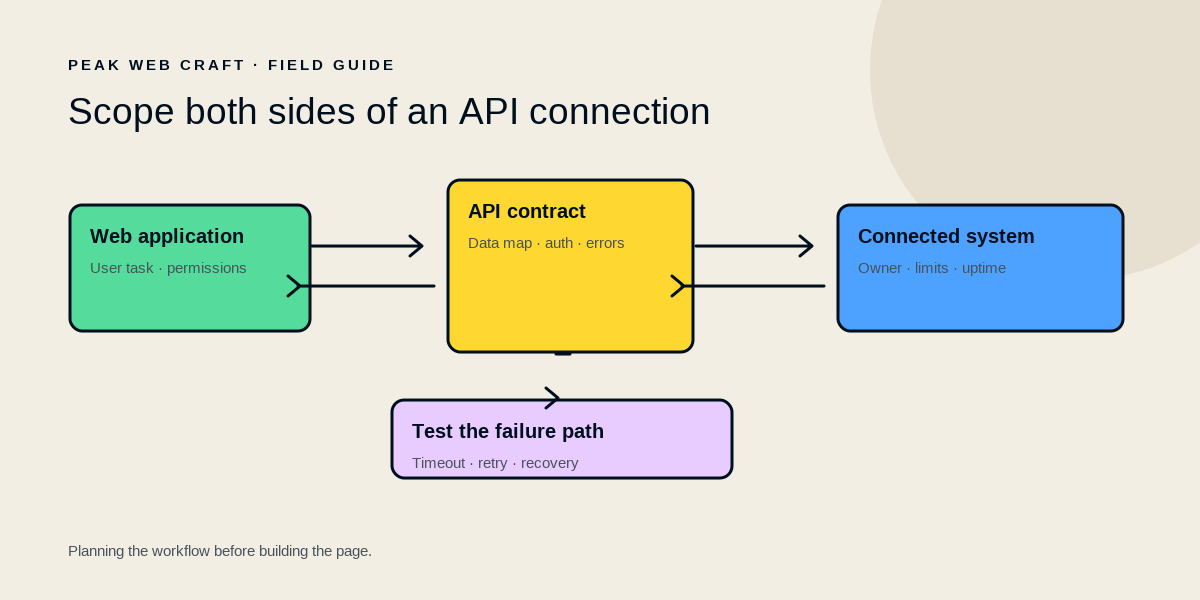
An API integration connects a web application with another system through a defined interface. Before development, agree which system owns each piece of data, what actions the connection may perform, how identity and permissions work, and what the user sees when a dependency fails. These decisions shape scope, testing and support just as much as the endpoint list.
TL;DR
- Draw the data flow and name the authoritative source for every exchanged field.
- Confirm API access, authentication method, permissions, environment, limits and vendor ownership.
- Document request and response shapes, error cases and version expectations.
- Plan for timeouts, duplicate events, unavailable services and safe recovery.
- Test authorization and failure behaviour, not just a successful example request.
Describe the workflow and data flow before selecting endpoints
Start with a task such as creating an order, syncing a contact, importing a report or displaying a customer record. Draw which person or system starts it, where the data travels, which service accepts the change and what response the application needs. This makes it easier to see whether the integration is one-way, two-way, immediate or scheduled.
| Flow detail | Question to answer |
|---|---|
| Trigger | What action or schedule starts the exchange? |
| Source of truth | Which system owns the value if systems disagree? |
| Data fields | Which fields are required, optional or sensitive? |
| Direction | Does the application read, write or do both? |
| Confirmation | What proves the remote system accepted the operation? |
| Owner | Who maintains credentials, access and vendor coordination? |
Avoid treating an API as a generic pipe between products. Each connected system has its own data model, limits, permissions, availability expectations and change process.
Confirm authentication, authorization and account ownership
Identify how the connected service authenticates a request, where credentials are stored, who may rotate them and how access is revoked. Then define which records and operations the application is allowed to access. Authentication identifies the connection or user; authorization determines what that identity may do. A working token does not prove that record or action permissions are correct.
- Confirm who owns the vendor account and can approve the required API access.
- List the specific scopes or permissions needed and remove access that is not used.
- Keep secrets out of browser code, source control, screenshots and error messages.
- Decide how credentials are issued, rotated, monitored and revoked.
- Test each user role against the records and operations it should be allowed to use.
- Document environment separation for development, testing and production.
The OpenAPI Specification provides a standard way to describe HTTP API operations and security schemes; a machine-readable interface description can help teams review what is called. For security review, use the OWASP API Security Top 10 as one reference for API risks such as broken object- and function-level authorization. Neither document replaces a project-specific threat and access review.
Agree the API contract and how values map between systems
Document the operations, request fields, response fields, identifiers, allowed values and error responses the application relies on. Note whether a field can be absent, null, delayed or changed after creation. Map names and meanings explicitly; two systems may both use a field called “status” while defining it differently.
| Area | Example decision |
|---|---|
| Identifiers | Which stable ID links a record across systems? |
| Field mapping | How are local status values translated to the provider’s values? |
| Optional data | What happens if an expected field is missing? |
| Versioning | How are breaking API changes discovered and scheduled? |
| Duplicate requests | Can the action be retried safely, and how are duplicates identified? |
| Time values | Which time zone and format apply to dates and timestamps? |
Where the provider supports a schema or API description, review it with the implementation team and keep the agreed version with the project notes. Do not assume that a successful sample payload represents every valid response.
Plan for timeouts, rate limits and partial failures
A connected service can be slow, unavailable, rate-limited or return a result the application cannot interpret. Decide whether the user should wait, retry, continue with a saved draft or contact support. For asynchronous work, show a pending state and explain how the application will report the result.
- Set a realistic timeout and identify which operations can be retried.
- Prevent a repeated user action from creating duplicate records or charges.
- Define how rate-limit responses and temporary outages are handled.
- Preserve enough context to investigate a failed request without logging secrets.
- Show a user-facing status that separates accepted, pending and failed work.
- Assign responsibility for monitoring, reconciliation and manual recovery.
If two systems can be updated separately, there may be a period when only one reflects the intended change. Document how to detect and resolve that state rather than promising an atomic update the providers do not support.
Test permissions and data boundaries alongside successful responses
Integration testing should include more than a happy path. Test the application’s expected behaviour when a user cannot access a record, an API credential expires, a field is missing, the provider returns a validation error or an operation times out. Verify that the user sees a useful message and that the application does not expose tokens or unrelated data.
- Use test accounts and non-production data where the provider supports them.
- Check that a user cannot retrieve another customer’s object by changing an identifier.
- Check that lower-privilege users cannot call administrative operations.
- Test malformed, incomplete, duplicate and out-of-order responses where relevant.
- Confirm logs support debugging while excluding credentials and unnecessary personal data.
- Record provider versions, access scopes and test cases for handover.
OWASP highlights object-level and function-level authorization as API security risks. Use its guidance as a prompt to verify the boundaries relevant to this integration, and involve the responsible security or platform owner where the data or impact warrants it.
Make long-term ownership part of the project scope
An integration remains dependent on the connected provider, account permissions and API behaviour after launch. Name who receives outage notifications, can coordinate vendor access, reviews API changes and approves credential rotation. Include operational steps for reconciliation, retry and fallback in the handover so the business can respond when an external system changes.
If the integration is one part of a wider workflow, pair this guide with the web application requirements checklist and the custom application versus off-the-shelf comparison.
Peak Web Craft scopes supported system connections as part of its Custom Web Application Development service. The project brief should identify provider access, data ownership, error behaviour and ongoing responsibilities before the interface is finalised.
Frequently asked questions
What information is needed to scope an API integration?
List the user workflow, connected systems, trigger, data fields, direction of travel, source of truth, access method, permissions, expected volume, failure behaviour and person responsible for each provider account.
What is the difference between API authentication and authorization?
Authentication establishes which user or system is making a request. Authorization determines which records and operations that identity is allowed to access.
Should API credentials be stored in frontend code?
Private credentials should not be exposed in browser-delivered code. Agree a secure server-side handling and rotation approach with the technical owner.
How should an application handle an API outage?
The right response depends on the operation. Define a timeout, safe retry or fallback, visible pending or failure state, and a way to reconcile actions that did not complete.
Does using OpenAPI make an integration secure?
No. OpenAPI can describe an interface and its security schemes, but the implementation still needs appropriate authentication, authorization, validation, secret handling, testing and operational controls.