
A. Choosing the right service
Outsource Web Development in India: Compare Delivery Models
Compare freelance, studio, agency and in-house web development models in India by project fit, communication, quality checks, ownership and handover.
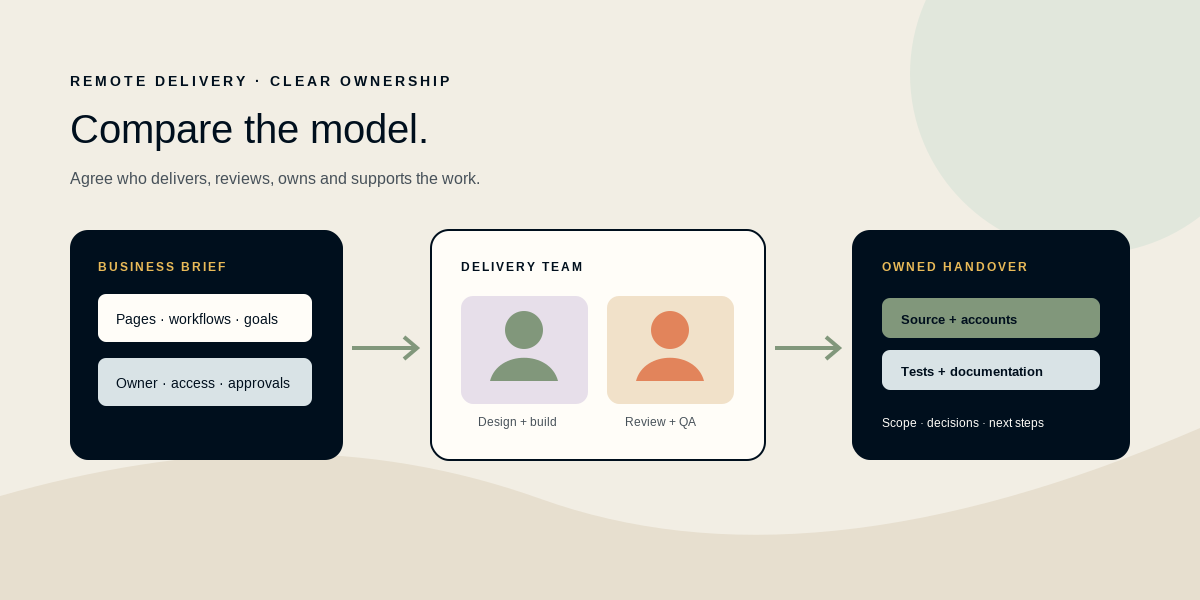
Outsourcing web development in India can mean hiring an independent developer, a specialist studio, a larger agency or a distributed extension of your own team. The label alone tells you little about who makes decisions, what is delivered or who owns the finished site. Compare each option against your project requirements, review capacity, communication needs and the work your team will manage after launch.
TL;DR
- Choose a delivery model by project scope, decision needs and required specialist skills.
- Compare written deliverables, assumptions, review rounds, testing and acceptance criteria.
- Agree who controls the domain, hosting, source code, business accounts and third-party licences.
- Plan communication, access and handover before development begins.
What web development outsourcing can mean
Outsourcing describes where some delivery work sits; it does not define the quality or accountability of the work. A freelancer may provide direct specialist access. A small studio may combine design and development. An agency may have broader roles and project management. An internal team may retain product knowledge while bringing in a partner for a defined gap. Ask who will do the work and who is responsible for decisions rather than comparing labels alone.
| Model | May fit when | Clarify before committing |
|---|---|---|
| Independent specialist | The brief is bounded and you can coordinate adjacent work. | Availability, backup coverage, design or content dependencies, testing and handover. |
| Boutique web studio | You want a small team to connect design, development and agreed launch work. | Named roles, work included, review cadence, capacity and who handles specialist integrations. |
| Larger agency | The project needs several disciplines, formal coordination or a broader delivery team. | Who will work on the account, which services are in scope and how approvals or change requests work. |
| Internal team with an external partner | Your staff own product and business decisions but need additional delivery capacity. | Responsibility boundaries, repository and account access, documentation and ongoing support ownership. |
For a more direct comparison of team types, see the freelancer, studio or agency website guide. This article focuses on how to evaluate remote delivery and project control once you are considering outsourcing.
Match the delivery model to the project
A content-led business website, a product catalogue with checkout and a web application with user-specific workflows create different delivery needs. Describe the work first: the pages or workflows, integrations, migration, content, access needs and decisions your team must make. A proposal can then explain whether one provider can cover the scope or whether you should retain separate specialists.
- Identify the business outcome and the visitor or staff tasks the site needs to support.
- List the page types, content sources, integrations and important existing URLs.
- Separate required launch functionality from ideas that could follow later.
- Name the people who approve content, design, access and launch decisions.
- Ask how proposed platform choices affect editing, dependencies and continuing maintenance.
The website development brief checklist can help turn these inputs into a comparable request. Peak Web Craft scopes business websites, ecommerce websites and custom web applications around the agreed project requirements.
Compare deliverables and accountability
Ask every provider to describe the output in terms you can review. A line such as website development may hide important differences in page templates, content entry, form connections, responsive behaviour, search setup, testing and deployment. Record what the provider supplies, what you supply, what depends on a third party and how a change to the scope is handled.
| Area | Ask the provider |
|---|---|
| Design and content | Which page types, design reviews, copy inputs and media preparation are included? |
| Development | Which features and integrations are configured, customised or newly built? |
| Quality checks | Which browsers, viewports, forms, workflows and failure states will be checked? |
| Project controls | Who is the day-to-day contact, what decisions do you need to make and how are delays or changes recorded? |
| Acceptance | What demonstrates that each deliverable is complete and ready for handover? |
A provider should be able to discuss relevant work and explain the part its team completed. Ask for a walkthrough of a similar project, the constraints it addressed and how the work was tested. Treat a visual reference as evidence of presentation, not proof that the same workflow or result will transfer to your project.
Set communication, security and access expectations
Remote delivery works best when questions and approvals have a clear route. Agree a project contact, meeting or written update rhythm, response expectations, decision log and the person who can resolve a business question. If your team is in another time zone, write down the overlap needed for reviews rather than assuming everyone will be available at all hours.
- Create project accounts in the business owner's name where practical, then grant named, least-needed access.
- Use an agreed method to share credentials and remove temporary access when it is no longer needed.
- Identify who owns the domain, hosting, source repository, analytics, email and paid services.
- Document where project files and decisions are stored and who can approve a release.
- Agree how personal information, customer records or production access will be handled for the project.
For sensitive data or regulated work, have the relevant technical and legal owners review the access and contractual arrangements. A website proposal should make operational dependencies visible; it cannot replace organisation-specific security or legal review.
Compare proposals using the same project scenario
- Send each provider the same short brief and representative examples.
- Mark each requirement as included, excluded, dependent on you or subject to discovery.
- Compare the people doing the work, project stages, review points and assumptions.
- Ask how testing, change requests, launch responsibility and handover are handled.
- Compare the quoted amount with the work, recurring third-party costs and ownership described.
- Resolve open questions in writing before choosing a delivery model.
The lowest or highest proposal is not automatically the best fit. If the scopes differ, ask for the missing work to be priced or for the scope to be adjusted before treating the figures as comparable. A short discovery phase may be appropriate when the key workflows or integration constraints are not yet understood.
Frequently asked questions
What does it mean to outsource web development in India?
It means hiring an external individual or team in India to handle some or all of a website or web application project. The scope may include planning, design, development, integrations, testing or handover; the proposal should identify exactly which work is included.
Should I hire a freelancer or a web development studio?
A freelancer may suit a bounded task when you can coordinate other roles. A studio may suit a project that needs a small team to connect design, development and agreed delivery work. Compare the actual people, responsibilities, availability and scope rather than assuming one model is always better.
How can I compare web development outsourcing proposals?
Give each provider the same brief, then compare deliverables, exclusions, assumptions, review stages, testing, change handling, third-party costs, ownership and support responsibilities.
How do I protect access and ownership when outsourcing?
Keep business accounts in the organisation's control where practical, grant named and limited access, use an appropriate credential-sharing method, and document repository, domain, hosting, data and handover responsibilities.
Can I outsource a website project remotely across India?
Yes, remote collaboration can work when the project has clear contacts, documented decisions, agreed review times, representative content and defined approval responsibilities. Include those practices in the delivery plan.