
A. Choosing the right service
Custom Website Development in India: When a Template Stops Fitting
Learn when custom website development in India is justified by content structures, integrations or user workflows that a suitable template cannot support cleanly.
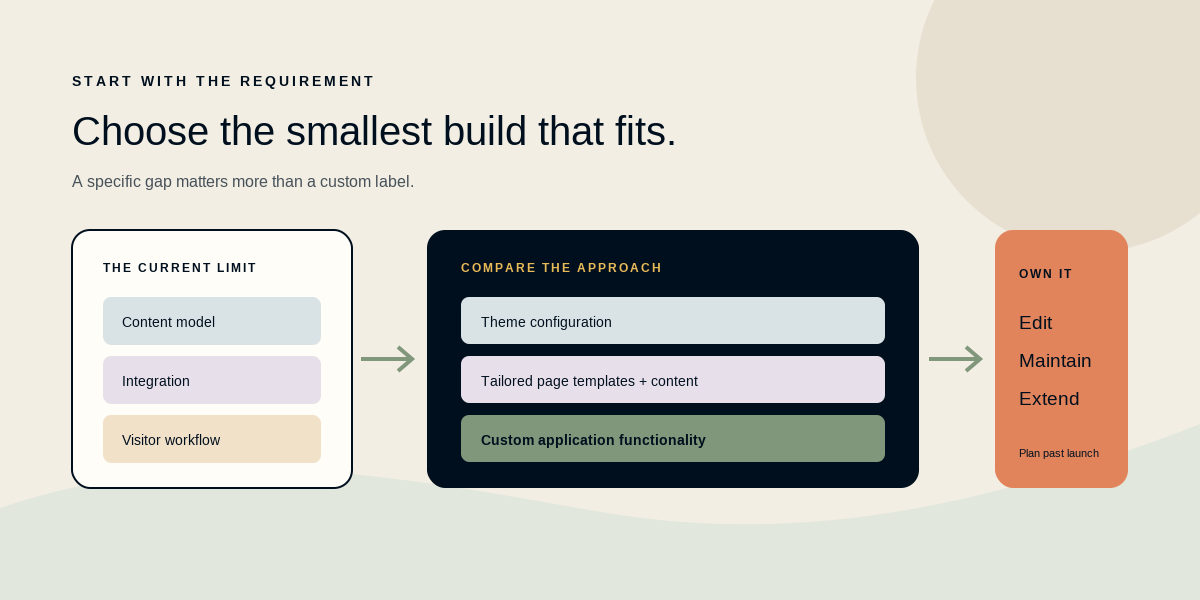
Custom website development in India can make sense when a business has content, integration or visitor workflows that a suitable template cannot support cleanly. It is not automatically better than a well-chosen theme or CMS. Define the limitation first, then compare the scope and ongoing responsibilities of customizing an existing system, building tailored website components or creating a more complex application.
TL;DR
- Begin with a business requirement and the limitation in the current template or platform.
- Separate custom visual design from custom content models, integrations and application functionality.
- Choose the smallest implementation that satisfies the requirement and can be maintained.
- Include editing, ownership, search foundations, testing and handover in the project scope.
Clarify what custom website development means
Custom can describe different levels of work. A business may use a standard theme with updated colors and content, commission tailored page layouts on a CMS, create a custom content model, connect a business system or build a web application with user-specific functionality. A proposal should state which components use existing platform features and which require new design or development.
Peak Web Craft is a website design and development studio in Ahmedabad; use this guide to compare us with any other provider.
| Approach | Typical scope | Question to ask |
|---|---|---|
| Standard theme or template | Configure existing layout patterns, replace content and set up required pages. | Does the theme support the pages, accessibility needs and editing controls we require? |
| Customized theme | Adapt existing components, page structures and visual design within the chosen platform. | Which changes are supported, maintainable and editable after launch? |
| Custom business website | Design and build tailored page templates, content structure or integrations for the business. | Which business requirement cannot be handled cleanly by the standard approach? |
| Custom web application | Develop interactive workflows, permissions, records or user-specific functionality. | Does the requirement need application logic and a separate technical architecture? |
This article focuses on general business websites. For commerce requirements, see the guide to custom ecommerce website development. For software with user accounts or operational workflows, review the custom web application service.
Look for a specific template limitation before choosing custom
A template may stop fitting when the page structures repeat in a way the theme cannot represent, the content team needs fields and previews the editor does not provide, an essential integration has no reliable supported path, or a visitor task requires functionality beyond the available components. Describe the limitation with an example and explain who it affects.
- A service or project type needs information the current page model cannot organize clearly.
- Staff repeat manual steps because a required form or approved integration cannot carry the right information.
- Several audiences need distinct paths that the current navigation or content structure cannot support.
- The team needs reusable editing controls that a theme does not expose safely.
- The site must preserve a migration, integration or permission requirement that the existing platform cannot meet.
A desire for a distinctive color palette, an animation seen elsewhere or the label bespoke is not by itself evidence that a custom build is necessary. First test whether a theme, component change or CMS configuration can deliver the required experience without creating avoidable maintenance work.
Choose the smallest solution that fixes the problem
| If the requirement is… | Evaluate… |
|---|---|
| A visual update or a few layout changes | A suitable theme, design system or targeted customization. |
| A repeated page type with structured fields | A CMS content model and a reusable page template. |
| A connection to another business tool | A supported integration, API constraints and failure handling. |
| A distinct multi-step user workflow | A custom web application or a system that already supports the workflow. |
| A store with product and order requirements | A suitable commerce platform or a separately scoped custom commerce approach. |
A smaller implementation can be easier to understand, hand over and extend. If a requirement is not essential for launch, record it for later review rather than adding speculative functionality that the business may not use.
Include maintenance and ownership in the comparison
Custom code creates responsibilities after launch. Ask who owns the source code, domain, hosting, integrations and paid tools; how the team will make future content edits; and what knowledge another developer would need to maintain the site. Compare initial implementation with recurring platform costs, updates, backups, monitoring and support rather than looking only at the build fee.
- Identify the person who can approve technical changes and who can edit public content.
- Document third-party services, account owners, API access and renewal responsibilities.
- Define representative acceptance checks for page templates, forms and integrations.
- Agree which content and metadata the team can update without developer assistance.
- Include documentation, training, access transfer and post-launch support boundaries.
The CMS decision may be related but distinct. The guide to CMS website development and editable content explains when an editor workflow justifies a CMS.
Build search foundations into the custom design
A custom implementation still needs clear page purposes, useful internal links, descriptive titles, crawlable content and appropriate index settings. Keep important content readable as text, use standard links to connect service pages and related guidance, and make structured data match visible page information. Add redirects and canonical checks when replacing existing pages.
Google's current guide for generative AI features says foundational SEO practices continue to apply, including crawlable content and a clear technical structure; it does not call for special AI-only schema. See the Google Search generative AI guide. For the page hierarchy, links and responsive checks that support search-ready design, read SEO-friendly web design foundations.
Peak Web Craft's business website service combines page architecture, responsive design, scoped CMS or integrations, technical search foundations and handover according to the project brief.
Frequently asked questions
When should a business choose custom website development?
Consider custom development when a documented content, integration, design or visitor workflow cannot be supported cleanly by a suitable template or platform. Compare the requirement with the maintenance and ownership responsibilities a custom implementation adds.
Is a custom website better than a template?
Neither is always better. A template can be effective when it supports the required content and tasks. Custom development can be useful when the business has specific requirements the standard approach cannot handle without fragile workarounds.
Does custom website development mean building a CMS?
No. A custom website can use an existing CMS, a static content workflow or another editor setup. Choose the content management approach based on what staff need to update and how frequently they make changes.
What should a custom website development proposal include?
Ask for page types, design and content responsibilities, integrations, migration, acceptance checks, account and source ownership, editing workflow, assumptions, exclusions and post-launch responsibilities.
Does a custom website improve SEO or AI search automatically?
No. Custom code does not guarantee search visibility. Useful content, crawlable pages and links, accurate metadata, technical configuration and a good page experience still matter.