
C. Shopify and ecommerce
Custom Ecommerce Website Development in India: When a Theme Is Not Enough
Identify when an Indian ecommerce business may need custom development by checking catalogue rules, buying journeys, integrations and merchant workflows against a suitable platform.
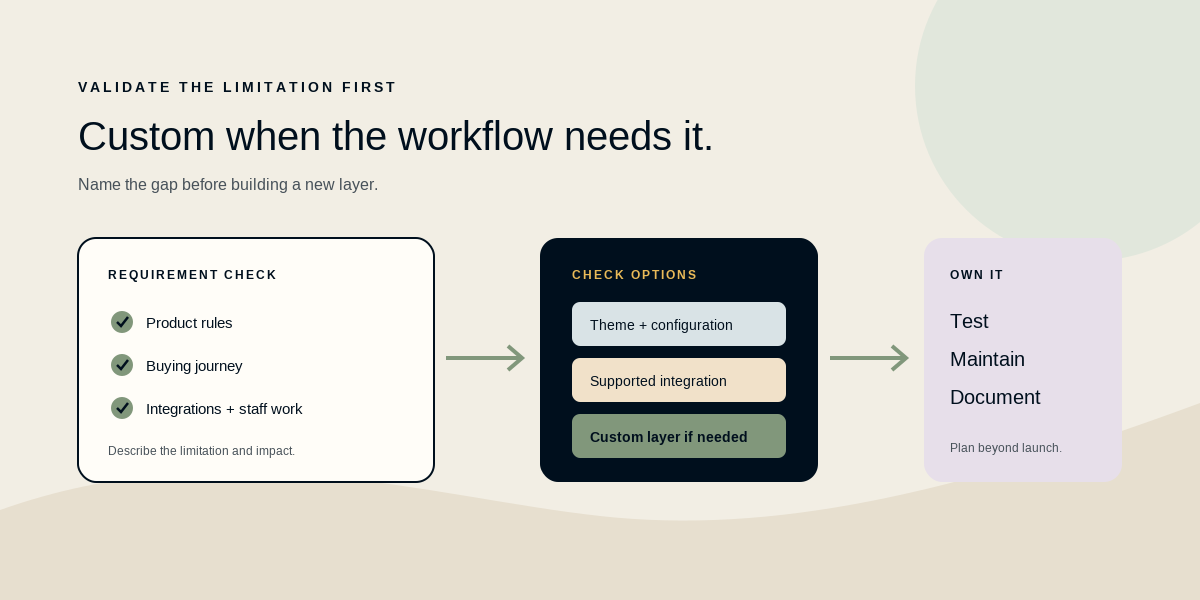
Custom ecommerce website development may be worth investigating when a product business has customer or staff workflows that an appropriate commerce platform cannot support cleanly. A distinctive visual design alone is rarely enough reason to build core commerce functionality from scratch. First identify the specific limitation, test available platform capabilities and compare the cost and responsibility of extending versus building the required workflow.
TL;DR
- Start with a repeatable customer or merchant problem, not the word custom.
- Check whether a supported theme, app, configuration or integration can meet the need reliably.
- Separate visual customisation from custom storefront, backend or commerce logic.
- Include ownership, security, testing and long-term maintenance in the platform decision.
Define what custom ecommerce development would change
Custom can describe several different scopes: styling and sections on a platform theme, a custom storefront connected to an existing commerce backend, or a custom application that manages core product, order or customer workflows. Those approaches have different dependencies and maintenance needs. Ask which parts are configured, which use supported extensions and which would be newly built.
The broader Shopify versus custom ecommerce guide compares the overall platform choice. This article looks more narrowly at the delivery signals that may justify a custom layer after you understand the selling and operating requirements.
Look for a concrete requirement a platform does not meet
| Signal | Question to answer |
|---|---|
| Product rules | Do products have configuration, pricing or eligibility rules that supported options cannot represent? |
| Buying journey | Does a customer need a quote, approval, subscription or assisted purchase before a regular order? |
| Order operations | Do staff need a repeatable order, fulfilment or status workflow that available platform tools do not cover? |
| Data connections | Which system owns product, inventory, customer or order data, and what supported interface is available? |
| User roles | Do customers or staff need distinct access and actions beyond the platform's normal account model? |
| Operating constraints | Are there documented performance, privacy or integration constraints that change the technical approach? |
A requirement is stronger when you can describe the current workaround, how frequently it occurs, who is affected and what a successful replacement should do. A preference for a particular technology or a one-off visual request should be evaluated against the business outcome and the upkeep it would create.
Test themes, configuration and supported integrations first
Before building custom commerce logic, check the platform's supported capabilities and the limits that matter to the workflow. Test representative products, a normal purchase, an exception and the staff steps required after an order. Review an app or extension for data access, compatibility, ongoing charges, vendor support and how a failure would affect the store.
- Confirm whether an existing theme can support the needed page structure and merchant editing controls.
- Check whether configuration or a supported app handles the required product or order behaviour.
- Identify where data is created, stored and updated across the platform and connected systems.
- Test the complete workflow with sample data before adopting a workaround across the catalogue.
- Record the exact limitation that remains and the impact of leaving it unresolved.
Peak Web Craft's Shopify development service covers store setup, theme customisation, custom themes and supported integrations. Its ecommerce development service supports broader commerce planning and custom approaches when requirements call for them.
Account for the responsibility that custom functionality adds
Custom functionality creates code and operational decisions your business must continue to understand. Ask who will maintain it, how updates are tested, what monitoring or backups are needed, which third-party services it depends on and how a new developer would learn the system. If an external provider or platform changes, consider what the business would need to do.
| Area | Clarify |
|---|---|
| Boundaries | Which components remain on the commerce platform and which are custom? |
| Data | What data is stored or exchanged, and which system is the source of truth? |
| Security | Who reviews access, dependency updates, user roles and sensitive data handling? |
| Testing | Which product, order, error and integration scenarios are included in acceptance checks? |
| Handover | What documentation, source access, deployment instructions and support options are supplied? |
Do not evaluate the custom build only by its initial delivery amount. Compare the implementation scope and the continuing work that keeps the solution reliable as products, integrations and business rules change.
Use this checklist before requesting a custom build
- Write down the customer or staff problem and the current workaround.
- Show the provider a representative product, order and exception case.
- Ask which platform features, theme changes or supported integrations were assessed.
- Define the expected result and how it will be tested with realistic data.
- Separate the first release requirement from optional future functionality.
- Document data access, account ownership, maintenance and handover responsibilities.
For the broader catalogue and order requirements to bring into discovery, use the online store requirements guide. A custom build should follow validated needs rather than substitute for deciding how the business will sell and fulfil orders.
Frequently asked questions
When does an ecommerce business need a custom website?
Consider custom development when a repeatable product, customer, order or merchant workflow cannot be handled cleanly by a suitable platform, its supported configuration or a reliable integration. Document the limitation and ongoing responsibilities before choosing a custom solution.
Is a custom theme the same as a custom ecommerce platform?
No. A custom theme changes the storefront presentation and may include theme behaviour, while a custom commerce platform may also replace or extend backend product, order, customer or business logic. Confirm which layer a proposal changes.
Should I choose Shopify or a custom ecommerce website?
Compare the platform capabilities with your catalogue, buying journey, integrations, editing needs and maintenance capacity. A platform can be a good fit when it supports the required workflow; custom development may be worth exploring where a documented limitation remains.
Does a custom ecommerce website always cost more?
The amount depends on scope, platform, data and integration needs, but custom functionality adds implementation and maintenance responsibilities that should be included in the comparison. Request a scoped proposal rather than assuming a universal price difference.
Can a custom ecommerce website use an existing payment provider?
That depends on the chosen platform, provider availability, merchant eligibility and technical requirements. Confirm the provider's current supported integration, account requirements, fees and error handling before scoping the implementation.