
C. Shopify and ecommerce
What Ecommerce Website Development Includes: Scope Checklist and Provider Questions
Understand ecommerce website development services, from catalogue and checkout requirements to integrations, testing and merchant handover.
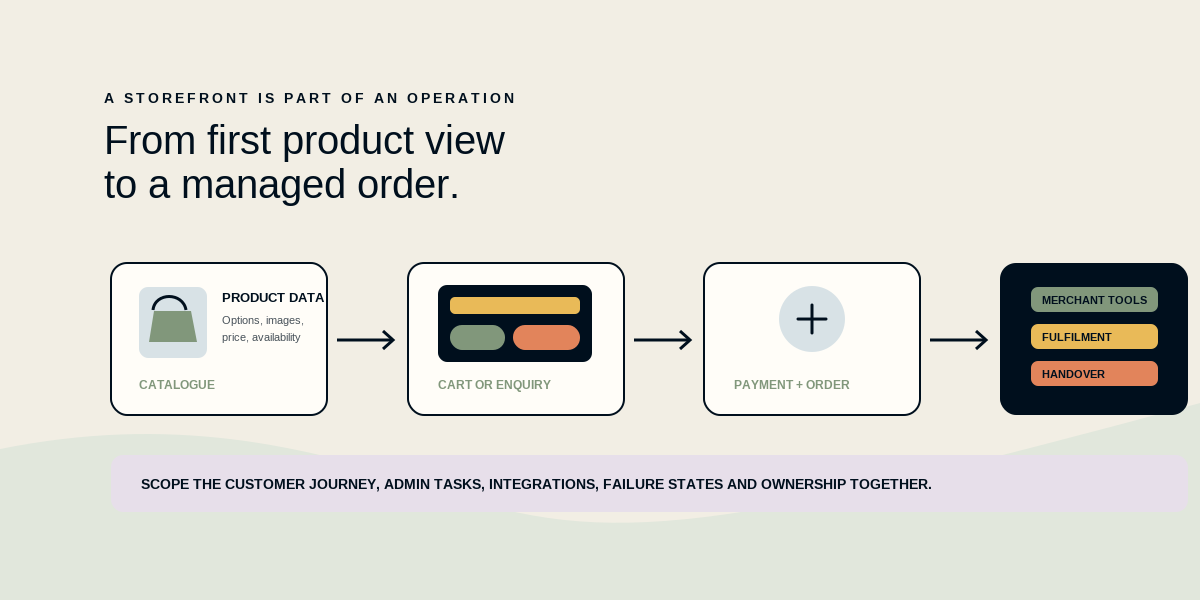
Ecommerce website development services should connect the storefront to the work of managing products and orders. A useful proposal explains the catalogue, purchase or enquiry journey, supported integrations, merchant tasks, failure-state testing and ownership included in the project. Compare that scope before comparing a feature list or platform name.
TL;DR
- Write down product data, sales rules and order operations before choosing a platform or custom build.
- Separate direct checkout from enquiry-led products and define how each route works.
- For each integration, identify the source of truth, data flow, failure handling and account owner.
- Agree representative testing, admin handover, platform access and post-launch responsibilities in writing.
What ecommerce website development services should include
An ecommerce project has two connected surfaces: what customers see and what the merchant team operates. The customer-facing work may include navigation, category pages, product details, cart or enquiry, checkout and order messages. The operational work may include product editing, inventory, order administration, fulfilment rules, reports and supported connections to other systems.
For the service itself, see our ecommerce website development in Ahmedabad page.
Peak Web Craft's ecommerce website development service is planned around commerce requirements and custom-scoped development. If Shopify fits the merchant workflow, the separate Shopify website development service covers platform-specific store and theme work. The correct choice depends on requirements, editing, integrations and maintenance—not a blanket claim that one platform is best for every business.
| Workstream | Confirm in the proposal |
|---|---|
| Discovery | Catalogue size and structure, customer journeys, policies and existing system constraints. |
| Storefront | Page templates, navigation, product data, filters, search and responsive behaviour. |
| Commerce flow | Cart, checkout or enquiry route; supported payment and fulfilment connections. |
| Merchant tools | Who edits products, manages orders, reconciles data and handles exceptions. |
| Launch | Content and data inputs, test cases, account access, training and agreed post-launch scope. |
Define the catalogue and selling model first
List product types, attributes, variants, identifiers, images, prices and availability rules. Decide which fields come from a system of record and who can change them. If the catalogue includes made-to-order, custom or quote-only items, specify how those products appear beside products that support direct checkout.
- Direct checkout: a customer can understand the offer, price, options, delivery and return conditions before paying.
- Product enquiry: a customer needs consultation, configuration or a quote before the business can accept an order.
- Hybrid catalogue: both routes are available, and every relevant product clearly identifies its next action.
- Existing store improvement: first review catalogue structure, platform limits, data quality and current order operations before deciding to rebuild.
For a worked example of the design consequences, see ecommerce website design examples for Indian brands. For a deeper requirements inventory, use what an online store needs beyond a shopping cart.
Plan integrations around data ownership and failure handling
An integration should support an identified task, such as keeping inventory in sync or sending paid orders to fulfilment. Name the system that owns each important record, the fields that move, which direction they move, when updates happen and how staff find out if a transfer fails. A connection without an owner or recovery path can create duplicate work and inconsistent customer information.
| Question | Why it matters |
|---|---|
| Which system is authoritative? | Prevents two systems from overwriting each other's correct values. |
| Which events and fields move? | Limits access and clarifies the operational behaviour being built. |
| What happens when a request fails or repeats? | Helps staff spot a missed update, duplicate event or delayed order. |
| Who owns the provider account and credentials? | Keeps billing, security and access responsibility clear. |
| How is the connection tested and supported? | Defines a way to verify normal, error and recovery scenarios. |
Compare a platform setup with custom development by fit
An established commerce platform can provide managed cataloguing, checkout and merchant administration when its supported features fit the business. Custom development may be worth evaluating when a real buying workflow, data model or integration cannot be handled cleanly with available platform capabilities. Custom work also adds development, documentation and maintenance responsibilities, so additional control should solve a defined problem.
- Ask which requirements are supported natively, which use an app and which require custom work.
- Review recurring platform, app, payment and third-party charges separately from build scope.
- Check how staff will handle product, order and content updates after handover.
- For migration, inventory products, customers, orders, URLs and integrations; confirm what can and cannot transfer.
- Request assumptions and exclusions in writing so a lower headline scope is not hiding required work.
Avoid selecting a custom build because it sounds more flexible, or a platform because it sounds simpler. Compare the complete operating workflow, who maintains it and how a future developer can understand the implementation.
Test customer journeys and merchant work before handover
A store needs tests for normal purchases and the cases that can interrupt them. Use representative products, variants, addresses, discounts, fulfilment choices and payment outcomes. Check that order state and customer messages agree with the authoritative record, and that staff can complete the agreed administration tasks.
- Prepare test products with representative descriptions, options, prices and availability rules.
- Exercise each buying route from discovery through payment or enquiry confirmation.
- Test invalid options, interrupted payment, unavailable stock, failed notifications and duplicate events where they apply.
- Have the merchant team complete its common product and order tasks in the admin interface.
- Record launch ownership for domain, platform, apps, payment accounts, data, backups and support contacts.
Search foundations should also be part of the launch checklist: useful category and product information, crawlable navigation, distinct page metadata, image alternatives and appropriate indexing. Google says AI search uses the same technical eligibility and content fundamentals as Search and requires no special AI-only markup; see its generative AI feature guidance. Structured data, if used, must match visible page information.
Review relevant work for decisions, not just visual polish
Ask to see work that resembles your operational challenge. A relevant example should help explain the team's role, constraints, design decisions and implementation. Screenshots alone cannot show who supplied the content, how the store is maintained or whether the example supports the same workflow you need.
- Ask what the provider designed, developed, configured or integrated.
- Look for comparable catalogue structure or buying routes, not just a similar colour palette.
- Ask how mobile, product data and merchant editing were handled.
- Check whether the case study describes limitations and scope as clearly as the result.
- Treat client outcomes as project-specific evidence, not a promise for your business.
The Nidhi Halani project provides an example of collection browsing with product-specific consultation enquiries. The Theka Coffee project separates product information and distributor enquiries. These are useful references for particular decisions, not a claim that either sales model fits every merchant.
Questions to ask before choosing an ecommerce company
- How will you validate our selling model and catalogue before selecting the platform?
- Which requirements are included, and which depend on apps or custom development?
- How will you test payment interruptions, invalid variants and order notifications?
- Who will own the accounts, integrations, product data and source materials?
- What should our team prepare, approve and learn before handover?
- How are changes, recurring fees and post-launch requests handled?
A provider should be able to answer in concrete terms without promising a fixed sales or ranking result. Review the studio's ecommerce service scope alongside its proposal and ask for clarification where the two differ.
A short scorecard for comparing ecommerce proposals
| Compare | A complete answer identifies |
|---|---|
| Deliverables | Pages, components, workflows, integrations and documentation included. |
| Inputs | Product data, photography, policy copy, credentials and decisions supplied by the merchant. |
| Testing | Representative customer journeys, admin tasks, failure cases and launch checks. |
| Ownership | Platform, domain, source code, apps, accounts and customer data responsibilities. |
| Ongoing work | Warranty or correction period if any, support route, change requests and recurring vendor costs. |
Frequently asked questions
What do ecommerce website development services include?
Depending on the agreed project, services can include commerce planning, storefront and product templates, catalogue setup, cart or enquiry journeys, checkout and payment connections, merchant tools, integrations, testing, search foundations and handover. Confirm each included deliverable in the proposal.
How do I compare ecommerce website development companies?
Compare the requirements they have documented, scope and exclusions, supported integrations, testing plan, ownership and handover. Ask how the proposed approach fits your actual catalogue and order workflow.
Should I choose Shopify or custom ecommerce development?
Choose based on whether the supported platform features, editing model and apps fit your needs. Consider custom work when a specific workflow or integration cannot be handled appropriately by an existing platform, and include its maintenance responsibilities in the decision.
Can an online store use product enquiries instead of checkout?
Yes. An enquiry-led catalogue can suit products that require consultation, configuration, a quote or a specification check. The product page should say what information to submit and what the next step is.
What should be included in ecommerce website handover?
Agree access and ownership for the domain, commerce platform, payment accounts, apps, integrations and source code where applicable. Include operating guidance, merchant tasks, launch notes, support boundaries and any recurring third-party costs.