
B. Portfolio websites
Creative Agency Portfolio Website: Organize Services, Work, and Enquiries
Plan a creative agency portfolio website around clear services, relevant project proof, team contribution and a practical collaboration enquiry path.
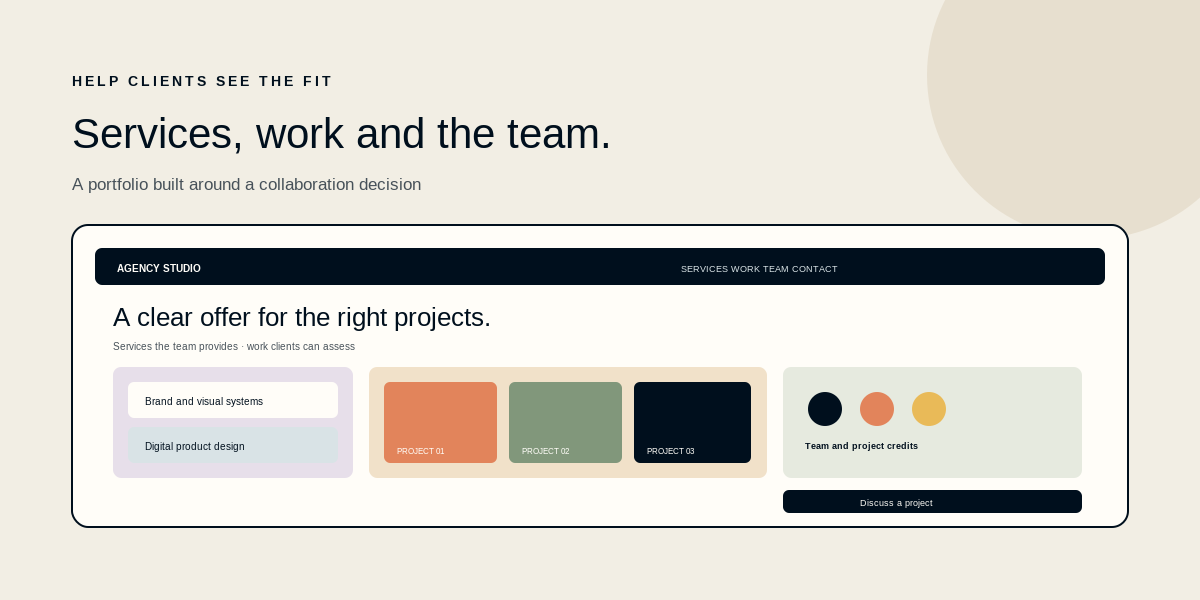
A creative agency portfolio website needs to explain both the work and how a client can engage the team. Visitors should understand the agency's actual services, see project examples relevant to their needs and learn who contributed. Organize the website around a prospective client's decision: fit, evidence, team and next step. Do not make the portfolio page carry promises or service details the agency cannot substantiate.
TL;DR
- State the agency's actual services and the kinds of projects it can take on.
- Organize work examples around client needs or service capabilities, not a decorative grid alone.
- Credit agency staff, partners and collaborators accurately on project pages.
- Show the agency's role and project context without claiming results it cannot verify.
- Use a collaboration enquiry that asks enough to route a project conversation.
Explain what the agency does and who it serves
Lead with the work the agency actually provides, the clients it is prepared to serve and the kinds of project it can support. A multidisciplinary team may group services by discipline, engagement or the stage of a client's project. Use categories that reflect how the agency operates rather than adding popular service labels that do not match its team or delivery capacity.
| Information | What a prospective client can learn |
|---|---|
| Service areas | Which kinds of work the agency offers and how they relate. |
| Engagement model | Whether work is scoped as a project, ongoing collaboration or defined service. |
| Client or project fit | Industries, organization types or project stages the team understands. |
| Team and partners | Who is involved and which capabilities are internal or collaborative. |
| Availability and next step | Whether the agency is open to a discussion and what information to share. |
Keep this page distinct from a freelancer or studio selection guide. The agency website should help clients understand this specific team's offer, evidence and process.
Organize portfolio work around the client's decision
A project gallery can help visitors scan quickly, but labels should explain why each project may be relevant. Consider grouping by service, project type or industry only when each group has enough accurate work to support it. If the agency works across several disciplines, make the relationship between those services and a project clear.
- List the real service areas the agency wants to grow.
- Choose projects that demonstrate a meaningful example of each capability.
- Group examples by a client-relevant distinction, such as project type or service.
- Use labels and thumbnails that identify the work without unsupported claims.
- Link each example to a detailed page when context will help a client assess fit.
- Remove or update work that no longer represents the agency's current offer.
A multidisciplinary agency may have fewer published projects in one category than another. Avoid creating empty or thin portfolio sections just to make the service list look broad. Explain the agency's current capacity honestly.
Use project pages to show scope, role and collaboration
Each project page should state the client's context, the work the agency was engaged to do and who contributed. Explain the decisions or production steps that are useful for understanding the result. When a project involved partners, specialists or a client team, credit their work and avoid implying the agency delivered every element alone.
| Detail | What to include |
|---|---|
| Project context | Client or project category, goals and constraints that can be shared. |
| Services delivered | The disciplines and deliverables the agency actually provided. |
| Agency role | Responsibilities held by the team and how they worked with the client. |
| Team credits | Contributors, partner organizations and approved photography or media credits. |
| Outcome | Verified launch details, approved results or clearly stated project status. |
| Related service | A link to the capability a prospective client may want to discuss. |
If a case study is confidential, use an approved summary, remove identifying details or leave it out. Do not reveal a client's private information, unpublished material or metrics without permission.
Show how the agency team collaborates
A prospective client may want to know who leads the project, which disciplines participate and how decisions are made. Explain the collaboration model at a useful level: discovery, reviews, client feedback, handoff or ongoing support, depending on how the agency actually works. Avoid presenting a large process diagram if the team cannot follow it consistently.
- Introduce team members by relevant expertise and role.
- Clarify when the agency uses a specialist or external partner.
- Explain how the client reviews work and who provides approvals.
- Describe deliverables and handoff expectations in plain language.
- Use team photography and project credits only with consent and accurate attribution.
If a prospective client needs deeper detail, link to a service page or a project story rather than repeating the entire process on every page.
Create a collaboration enquiry with enough context
The agency's enquiry route should invite a conversation and collect enough information to route it. Ask for a name, a reliable contact method and a short project summary. Add service interest, timing or budget only when those details help the team respond and the business can explain why it needs them.
- Use a direct action label such as discuss a project or request a consultation.
- Show examples of projects the agency is prepared to consider.
- Make required fields and optional details explicit.
- Confirm receipt and describe a realistic response process.
- Offer an alternate route if the visitor cannot use the form.
- Link the enquiry to the relevant service or case study that prompted it.
For a field-by-field guide to an accessible business enquiry, see business website contact form design.
Keep the agency portfolio accurate as the offer changes
Agencies evolve: service priorities shift, teams change and older projects may no longer represent current capabilities. Assign an owner for service details, project credits, images and enquiry routing. Review the site when staff, partner relationships or case study permissions change.
- Set an owner for each service description and project page.
- Keep source files and image permissions with the project record.
- Review team names, service availability and contact destinations on a schedule.
- Retire or update examples that no longer reflect the agency's current work.
- Test the enquiry route and linked service pages after site updates.
For a more process-led portfolio focused on studio case studies, see design studio portfolio website guidance. Peak Web Craft's portfolio website development service supports work stories, responsive media and enquiry paths within an agreed scope.
Frequently asked questions
What should a creative agency portfolio website include?
Include the agency's actual services, relevant selected work, project context and team contributions, a clear collaboration process and a practical enquiry path.
How should a creative agency organize its portfolio?
Group projects by distinctions clients use to evaluate fit, such as service, project type or industry, when there is enough accurate work for each group. Use clear links to detailed case studies.
What should an agency case study explain?
Explain the project context, the services delivered, the agency's role, collaborators, approved evidence and the status or outcome of the work.
Should an agency list every service it could provide?
List the services the agency actually offers and can support. Avoid broad labels that are not reflected in its team, partner network or delivery capacity.
What should a creative agency project enquiry form ask?
Collect a reliable contact method and a short description of the project. Add service, timing or budget questions only when the team uses those answers to route or respond to enquiries.