
D. Business websites and CMS
Business Website Development in India: Scope, CMS, and Handover
Plan business website development in India with a clear page scope, content responsibilities, CMS needs, integrations, QA and ownership at handover.
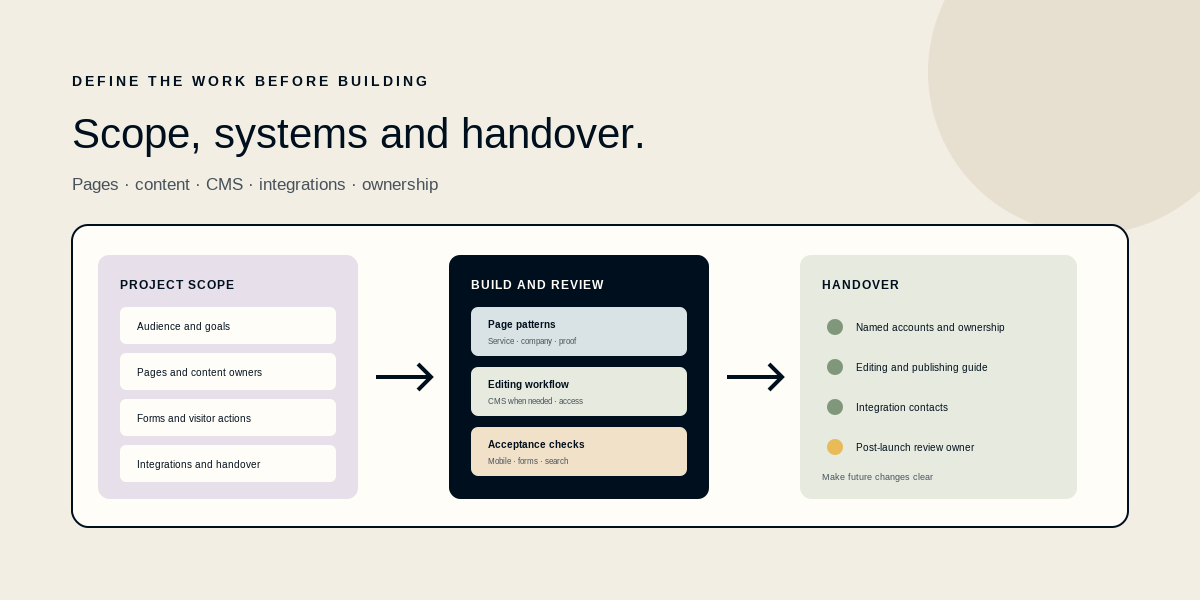
Business website development in India works best when the business defines what the site must explain, what visitors should do and what the team will need to maintain. A clear brief covers pages, content, forms, integrations, optional CMS requirements, testing and handover. These decisions help a business compare proposals on the work included, not just on a headline page count or platform name.
TL;DR
- Define the audience, business goal and customer actions before choosing a page count.
- List page types, content owners, forms and system integrations in the project brief.
- Choose a CMS only where the team needs to edit content and can maintain it.
- Agree responsibility for copy, images, approvals, testing and access before launch.
- Include technical, mobile and handover checks in the delivery scope.
Start with the business and customer task
Write down who the site needs to serve, what they need to understand and what they can do next. A service firm may need clear scope and an enquiry path; a company with multiple business lines may need navigation that helps visitors reach the right team. Begin with those decisions instead of copying another website's page list.
For a scoped build, see our business website development in Ahmedabad service, which works from this checklist.
| Question | How the answer affects scope |
|---|---|
| Who visits the site? | Sets audience language, page priorities and proof needs. |
| What do visitors need to decide? | Shapes service information, company context and project evidence. |
| What is the next useful action? | Determines forms, booking links, phone details or resource paths. |
| What does the team need to update? | Informs CMS fields, editor roles and handover documentation. |
| Which systems need to connect? | Defines integration behavior, access needs and acceptance checks. |
For a structured prompt list, start with the website development brief checklist. This article focuses on how those answers shape an India-focused business website scope.
Create a page map around services and visitor questions
Group pages by the questions visitors ask rather than by internal department names alone. A company site may include a homepage, service pages, company information, work or case studies, FAQs and contact details. Each page should have a job and a clear relationship to the rest of the site.
- List the audiences and the questions they bring to the site.
- Map each important question to a page or section that can answer it.
- Identify which services need distinct pages because their scope or buyer differs.
- Connect pages through navigation and contextual internal links.
- Mark pages that need original proof, photography or client approval.
- Remove duplicate or low-value pages before design begins.
A business website page list is not the same as a page count commitment. Some pages need unique content and design; others can use a shared pattern with different approved details. Ask how template reuse and page-specific work will be described in a proposal.
Decide which content the business will maintain
Identify who supplies and approves copy, photography, logos, project facts and policies. Then decide which information will change often enough to justify editing controls. A CMS can support service pages, case studies or articles, but the business needs an owner for updates, permissions and content review.
| Content | Owner or decision |
|---|---|
| Service copy | Who confirms scope, availability and accurate claims? |
| Project evidence | Who approves client names, project details and image use? |
| Images and media | Who supplies optimized files, captions and credits? |
| Policies and contact details | Who checks that published information stays current? |
| CMS editing | Who drafts, reviews, publishes and maintains pages? |
If the team is moving from a static site, use the CMS migration checklist to plan URL and content changes. For reusable field patterns, see CMS website examples.
Specify forms, integrations and operational behavior
Describe what a feature should do from the visitor's and staff member's perspective. A contact form may need to route by service, send a confirmation and notify a team mailbox. An integration may need a named system owner, access credentials and an agreed failure behavior. Avoid describing a tool name without defining the required workflow.
- Document form fields, notifications, confirmation and the team that receives requests.
- List scheduling, CRM, analytics or email tools that must connect and who owns access.
- Identify multilingual or location-specific content only when the business needs it.
- Clarify whether the project requires account access, gated content or user-specific data.
- State what should happen if an integration is unavailable or a submission fails.
- Separate routine web pages from custom application workflows that need data, roles or approvals.
For a focused review of enquiry form fields and error states, see business website contact form design. If a workflow needs more than public information pages, compare it with the custom web application service.
Agree launch checks and delivery responsibilities
Before development begins, agree who provides content, who approves designs, who configures systems and who accepts the finished site. Include time for testing representative page templates, forms, navigation, mobile layouts, redirects when needed and analytics or search tools the business uses.
| Area | What to verify |
|---|---|
| Content | Approved service descriptions, contact details, project facts and media are present. |
| Navigation | Important pages are reachable through clear, working links. |
| Forms and integrations | Requests reach the intended team and failure states are understood. |
| Mobile and accessibility | Pages remain usable at narrow widths and with keyboard input. |
| Search foundations | Titles, descriptions, canonical routes and sitemap behavior match the launch plan. |
| Access and handover | The business receives agreed accounts, documentation and update instructions. |
A handover should say what the team can edit, where to get help and which changes need development. Record ownership of domain, hosting, analytics, email notifications and third-party accounts rather than assuming the developer will retain them.
Compare proposals by deliverables and ownership
Ask each provider to show what is included: page types, design revisions, content responsibilities, CMS configuration, integrations, testing, launch support and handover. A lower estimate may reflect a smaller scope, while a larger estimate may include work your business does not need. Request clear assumptions and exclusions before comparing totals.
- Confirm the scope and named deliverables in writing.
- Ask which team supplies and approves content and images.
- Clarify who owns the design files, code, accounts and site access after delivery.
- Agree how requested changes outside the initial scope are handled.
- Identify the person who can approve work and respond to questions during delivery.
- Use the same brief when comparing proposals so their assumptions are visible.
This article focuses on defining a project brief and handover. For a provider-selection scorecard, see website development in India: how to evaluate a web studio. Peak Web Craft's business website development service is custom-scoped and can include CMS requirements when they fit the project.
Frequently asked questions
What should business website development in India include?
Define the business goal, page map, content owners, forms, integrations, mobile and accessibility checks, search foundations, launch responsibilities and handover. The exact scope depends on the site's requirements.
How many pages does a business website need?
There is no fixed number. Include pages that answer distinct visitor questions or explain services with materially different scope, and avoid duplicating pages without useful differences.
Does a small business website need a CMS?
A CMS may help when staff need to update pages or publish content regularly. Choose it based on editing frequency, ownership and maintenance capacity rather than assuming every site needs one.
What should a business website handover include?
Agree the handover contents in the project scope. It may include site and account access, editing instructions, integration ownership, documentation and a list of changes that require development support.
How should I compare business website development proposals?
Compare deliverables, assumptions, content responsibilities, CMS and integration scope, testing, launch support, ownership and exclusions using the same brief.