
A. Business websites
Website Development in India: How to Evaluate a Web Studio
Compare website development providers in India by scope, communication, relevant work, testing, account ownership and handover before you choose a studio.
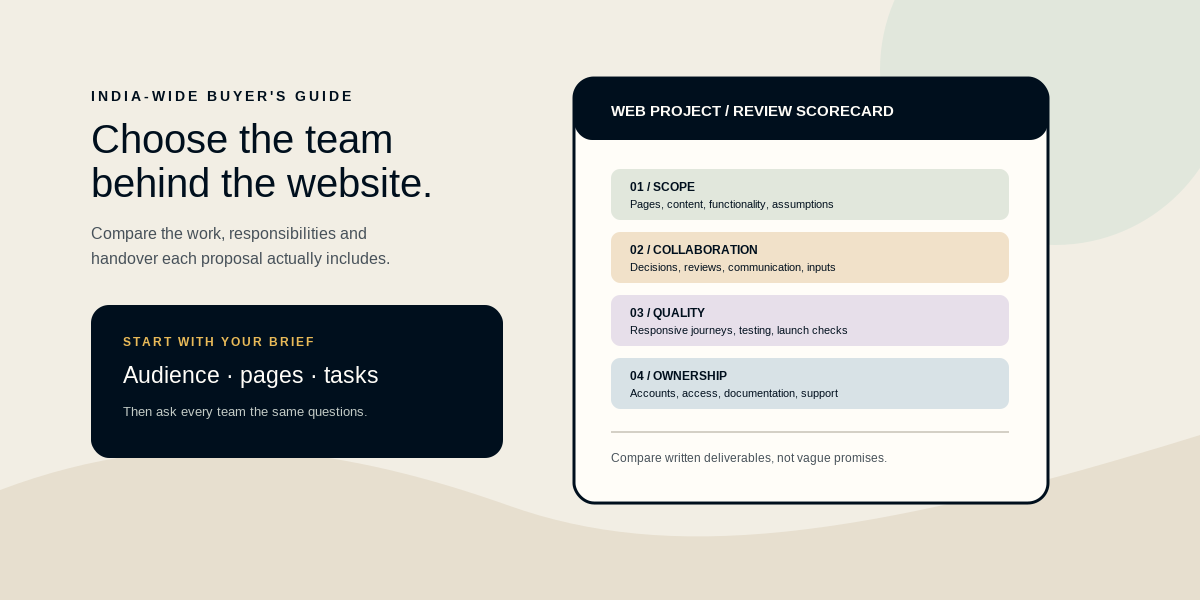
To evaluate website development in India, give each provider the same short brief and compare its proposed deliverables, assumptions, communication process, testing, ownership and handover. Relevant portfolio work matters, but a clear project plan tells you how the provider will handle your particular content, functionality and approvals.
TL;DR
- Start with the audience, pages, user tasks and project constraints you can describe today.
- Ask each studio to define what is included, what you must supply and what costs extra.
- Review communication, testing and ownership responsibilities before comparing proposals.
- Treat case studies as evidence of specific work, not as guarantees of your outcome.
Choose a provider for the work your website needs
A business website, ecommerce store and custom application ask for different experience. Begin by describing what the project needs to do: explain services, show work, collect enquiries, support orders or connect an internal workflow. Then check whether the proposed team can explain how it will handle those tasks—not only which framework or platform it prefers.
Peak Web Craft is a website development agency in Ahmedabad; use this guide to compare us with any other provider.
The company should ask questions about your audience, existing content, integrations, editing needs, approvals and launch constraints. A proposal made before those points are understood may depend on assumptions that later change the scope.
| Area | Evidence to look for |
|---|---|
| Project fit | Questions that clarify your audience, user task and existing site. |
| Relevant work | Examples that explain the provider's role and the decisions behind the work. |
| Scope | Named pages, content, functionality, integrations, testing and exclusions. |
| Delivery process | Decision makers, review stages, communication and issue handling. |
| Ownership | Access to the domain, platform, code or files, analytics and vendor accounts. |
Compare deliverables and assumptions side by side
A quote is easier to compare when the work is described in similar terms. Ask what page templates, responsive states, forms, CMS editing areas, integrations, migration tasks and launch checks are included. Also record who supplies copy and imagery, who approves facts, and whether platform, hosting or paid-tool fees are included or separate.
- Deliverables: pages, templates, functionality, source or design files and documentation.
- Inputs: approved copy, imagery, data, account access and business decisions supplied by you.
- Assumptions: platform fit, third-party availability, migration condition and timeline dependencies.
- Exclusions: extra page types, subscriptions, custom integrations, content entry or ongoing work.
- Acceptance: who reviews the work, what constitutes completion and how requested changes are handled.
Use the web development studio brief checklist to give providers comparable context. This guide focuses on evaluation; the brief guide helps prepare the information they need to scope the project.
Review relevant experience without relying on screenshots alone
A polished portfolio is useful when it gives context. Ask what the provider personally designed, developed, configured or integrated, which constraints shaped the result, and who maintains the live site. Check whether the example has a similar audience or workflow rather than expecting an identical industry to prove fit.
| Question | Why it helps |
|---|---|
| What was the brief and your role? | Separates the provider's contribution from the client's or another team's work. |
| Which decisions were difficult? | Shows how the team handles constraints and tradeoffs. |
| What changed after launch? | Clarifies whether the solution is editable and maintainable. |
| What was out of scope? | Prevents interpreting a case study as a standard package. |
| What evidence supports the stated outcome? | Distinguishes documented facts from a broad marketing claim. |
Check how the team will collaborate across India
A project can work remotely when the review process and responsibilities are clear. Ask who your day-to-day contact is, how questions and approvals are recorded, what response expectations apply, and how the team handles blocked decisions. If meetings or in-person reviews matter to your organization, agree their format and frequency before the project begins.
Location can be useful for time-zone, language or workshop preferences, but a local address alone does not establish delivery quality. Peak Web Craft is based in Ahmedabad and collaborates remotely with businesses across Gujarat and India. Its local provider page explains that market context; this guide covers an India-wide selection process.
For a separate comparison of hiring models, read freelancer, boutique studio or agency: who should build your website?. For Ahmedabad-specific provider questions, see how to evaluate a web development company in Ahmedabad.
Make testing, ownership and handover part of the decision
Before choosing a web development company, find out how the work will be reviewed and what you receive at handover. A site may depend on domain and hosting accounts, a CMS, paid licences, analytics, form delivery or third-party integrations. Identify who controls each account and what access your team retains after the project.
- Ask which devices, browsers, forms and visitor tasks are included in testing.
- Confirm who checks redirects and useful existing URLs if the site is being redesigned.
- List the domain, hosting, CMS, analytics, email and third-party accounts involved.
- Ask what editing guidance, launch notes and documentation are delivered.
- Define how defects, new requests and support after launch are handled.
Google's guidance for AI features in Search points back to foundational SEO: indexed, discoverable pages, helpful content in text, useful internal links and structured data that matches the visible page. It recommends no special AI-only schema or content trick. See the Google Search Central guide.
Questions to ask before you sign
- Which person will lead the project and make day-to-day decisions?
- What pages and user tasks are included, and which requirements are assumptions?
- What content and approvals must my team provide, and by when?
- How will you test forms, integrations, mobile layouts and changed URLs?
- Which accounts and files will my business own and receive?
- How are project changes, recurring fees and post-launch requests handled?
The right provider should be able to explain tradeoffs plainly and put responsibilities in writing. If a proposal is unclear, ask for a revised scope before comparing its total with another provider's figure.
Frequently asked questions
How do I evaluate website development companies in India?
Give providers the same project brief and compare named deliverables, assumptions, relevant work, communication, testing, account ownership and handover. Ask how each team will handle your actual content and user tasks.
Should I choose a local web development studio?
Choose based on project fit, communication, relevant delivery experience and a clear scope. Location may matter for collaboration preferences, but it does not by itself demonstrate quality or technical fit.
What should a website development proposal include?
It should describe pages, functionality, content and client inputs, platform assumptions, integrations, testing, milestones, exclusions, account ownership and what happens after launch.
How can I compare website development proposals fairly?
Prepare one brief and compare each proposal against the same deliverables and responsibilities. Note what's included, excluded, assumed and billed separately, including third-party costs.
Does hiring a web studio guarantee search rankings or leads?
No. A provider can build agreed technical and content foundations, but rankings and enquiries also depend on audience fit, demand, content, competition, authority and ongoing operations.