
Website Strategy
Landing Page vs Business Website: Which Should You Build First?
Compare a focused landing page with a full business website and decide which to build first based on your offer, audience, traffic source and next step.
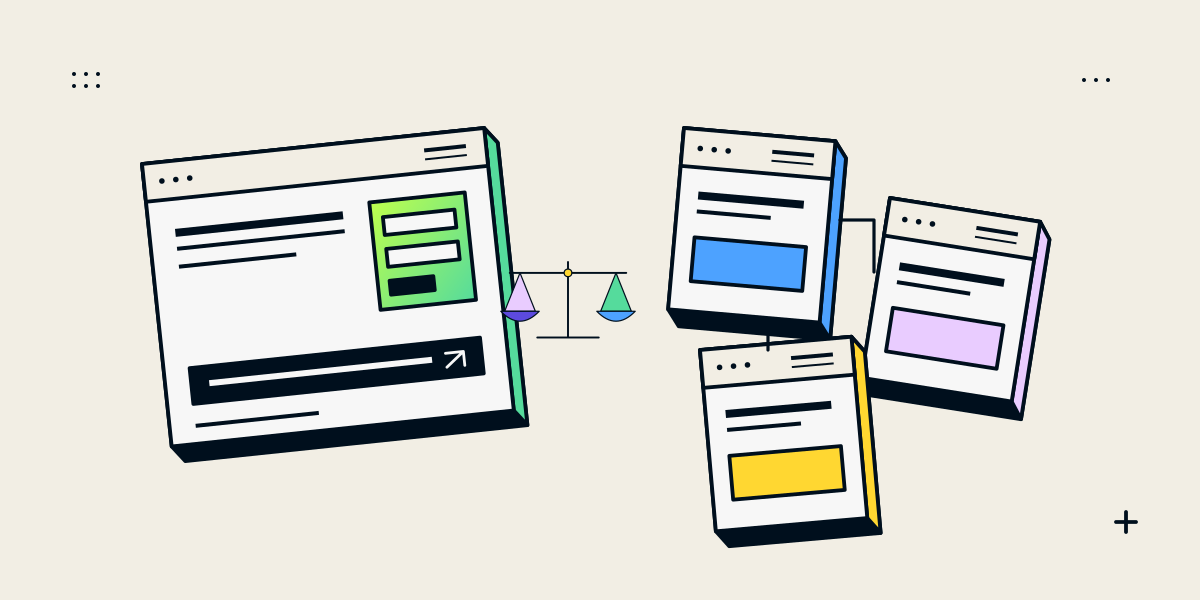
The short answer depends on what visitors need to do
A landing page gives one offer, campaign or launch a focused destination and a clear next action. A business website introduces the company across connected pages, with room for multiple services, proof and ways to make contact. Build a landing page first when one audience and one offer are ready to promote. Build a business website first when a prospect needs wider context before choosing a service.
| Decision point | Landing page | Business website |
|---|---|---|
| Main job | Explain one offer and guide one primary action | Explain the company and help people explore its services |
| Typical structure | One focused page with sections in decision order | Connected pages for the company, services, work and contact |
| Useful when | An offer, campaign or launch has a defined audience | Visitors need to compare several services or verify the business |
| Main risk | Too little context or an offer that is not ready | Too much general information without a clear route to act |
A company can use both. A landing page can serve campaign traffic while the main site provides broader information and long-term discovery. The pages should support the same business and make it easy to move between the focused offer and the context a visitor needs.
Choose a landing page when one offer is ready to explain
A campaign landing page is useful when the message, audience and action can be made specific. That action could be requesting a demo, registering for an event, asking about a service or reviewing a product launch. The page should answer the questions a visitor needs to resolve before taking that step.
- The campaign has a defined audience and a clear promise.
- The offer can be explained without describing the whole company.
- You know what action counts as a useful response.
- The page can show relevant proof and handle likely objections.
- The person receiving requests knows how to follow up.
If the traffic comes from an ad, align the page with the message the visitor clicked. Google Ads defines the landing page as the page a person reaches after clicking an ad, and its guidance describes relevance and usefulness as part of the landing page experience. See Google Ads’ landing page definition. This does not make a landing page a substitute for campaign targeting or a suitable offer.
A landing page can also be a poor first move if the offer, service area, price approach or contact process is still unsettled. Resolve those decisions before investing in a polished destination.
Choose a business website when people need broader confidence
A business website is a better starting point when visitors need to understand who the company is, compare distinct services, see relevant work or contact different parts of the business. It gives the organization a structure that can support more than one campaign or audience.
- Several services need their own explanation and enquiry route.
- Prospects need company information, process details or project examples.
- People arrive through referrals or search and need broader context.
- The business needs lasting pages that can be updated as its offer changes.
- Different visitor groups need different paths through the site.
A full website does not need a large sitemap. Start with the pages that answer real customer questions, then add sections when there is a clear purpose. Our guide to pages for a service business website outlines a useful core structure.
A landing page is not automatically the homepage
The homepage usually introduces the business and routes people to its main services or information. A landing page is a destination for a specific offer or audience. It may be linked from an ad, email or campaign, and it can sit on the same domain as the main site.
A homepage can support a campaign when the offer is central to the business and the page still answers the needs of other visitors. A separate landing page is useful when campaign visitors need a narrower story or a different action. Decide based on visitor intent, not the label assigned in a design file.
Plan discovery and measurement around the page purpose
A long-lived service page may be useful in search when it has distinctive content and a clear place in the site. A short campaign page may serve paid or email traffic without needing to become a permanent search destination. Decide whether each page should be indexed, linked from the site and maintained after the campaign ends.
Google’s SEO Starter Guide recommends organising a site in a way that helps users and search engines understand how pages relate. It also notes that no particular page is guaranteed to appear in search. Do not create several near-identical campaign pages with only small wording changes; give each page a useful reason to exist.
Agree what you will measure before launch. A button click is different from a delivered enquiry or a qualified opportunity. Record the primary action, who follows it up and how the team will review the result.
Use this checklist before choosing what to build
- Name the audience and the need that brought them to the page.
- Describe the offer in one clear sentence and list what a prospect needs to know.
- Choose the action the visitor should take and decide who will handle it.
- List the other company or service information that must be available.
- Choose the smallest page structure that answers the audience’s real questions.
- Plan how the page will be reached, measured and maintained.
If the answers point to one offer and one action, start with a landing page. If they require several services, broader proof and multiple paths, plan a business website. If the evidence is mixed, map the visitor journeys before commissioning either scope.
Questions about landing pages and business websites
Can I build a landing page before my main website?
Yes, when the offer is ready and the page can explain the business sufficiently for that audience. Plan the domain, contact route and future connection to the main site.
Can a landing page appear in Google Search?
It can be eligible if it is public, useful and technically accessible, but inclusion and ranking are not guaranteed. Indexing should match the page’s purpose and how long it will remain useful.
Should every ad have a different landing page?
Only when the offers or audiences need meaningfully different information. Repeated pages with minor text changes can make maintenance harder and may provide little value to visitors.
Can I use my homepage for a campaign?
Sometimes. Use it when the homepage clearly supports the campaign action without hiding the needs of other visitors. Otherwise, a focused page may be easier to align with the campaign.
Do I need a full website if I have a landing page?
Not always for the first campaign. A broader site becomes useful when prospects need connected services, company details, project evidence or more than one path to contact you.