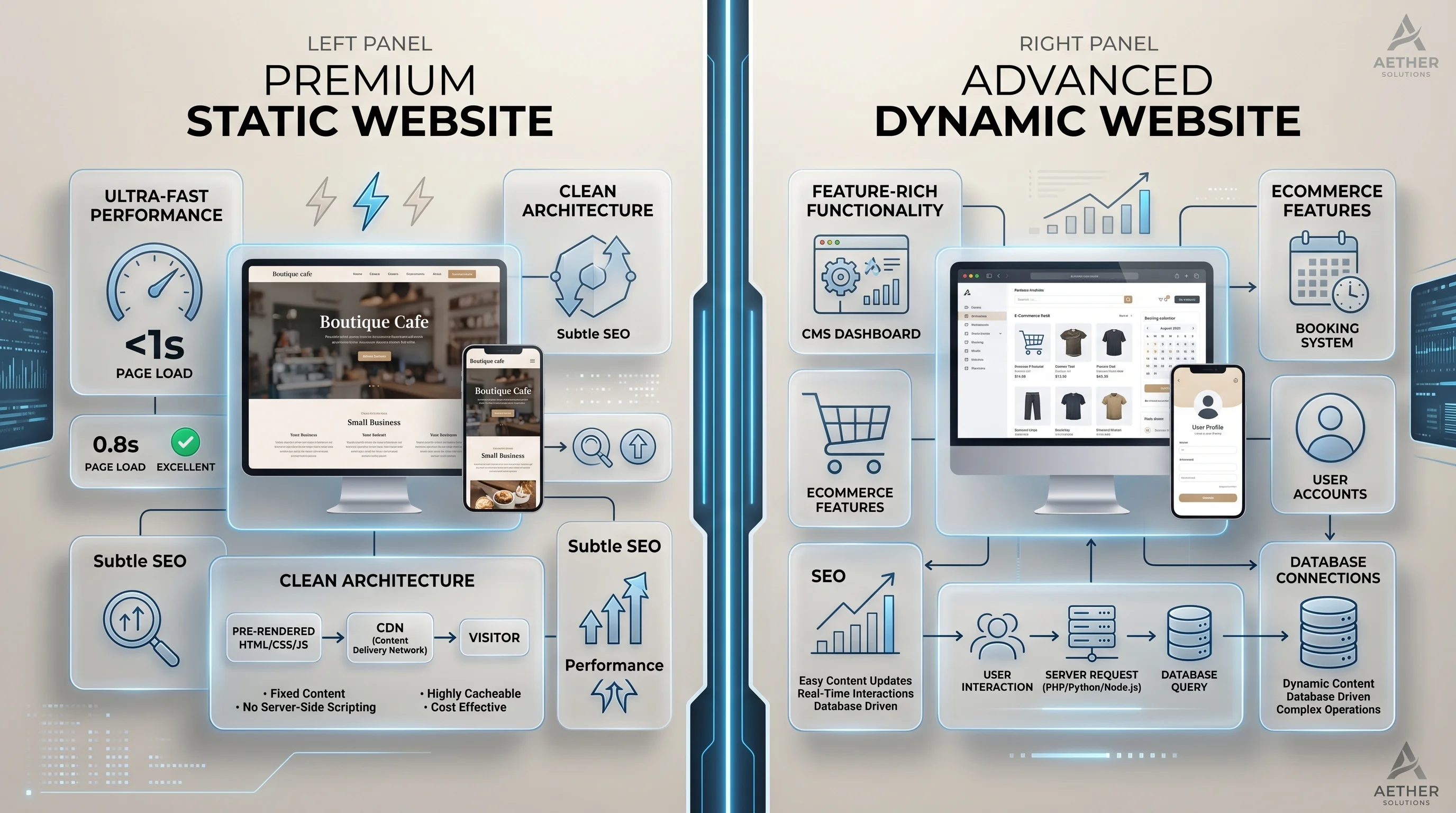
One of the first technical decisions in a website project is whether the website should be static or dynamic. The words sound technical, but the business question is simple: do you need a fast, mostly fixed website, or do you need a website that changes content, stores data, manages users, or connects to systems?
For small businesses, choosing correctly matters because it affects cost, speed, maintenance, SEO, security, and future flexibility. A static website can be perfect for a consultant, clinic, agency, or local service business. A dynamic website is better when the website needs a CMS, bookings, ecommerce, user accounts, listings, dashboards, or frequent content updates.
What Is a Static Website?
A static website is made of fixed pages that are delivered to visitors as prebuilt HTML, CSS, and JavaScript. The content does not change for each visitor unless a developer or content workflow updates the files. Static websites can still look premium, include animations, load quickly, and rank well on Google. Static does not mean boring. It means the page is not generated from a database on every request.
Best use cases for static websites
- Business websites with service pages, about page, case studies, and contact page.
- Portfolio websites for photographers, filmmakers, consultants, and creators.
- Landing pages for ads, launches, events, and lead-generation campaigns.
- Simple local business websites that need speed, credibility, and SEO basics.
- Websites where content changes occasionally rather than daily.
What Is a Dynamic Website?
A dynamic website generates pages using a database, CMS, server-side logic, APIs, or user input. The page can change based on products, availability, location, logged-in users, filters, search queries, bookings, or admin updates. Dynamic websites are more flexible, but they also need more planning, testing, security, hosting care, and maintenance.
Best use cases for dynamic websites
- Ecommerce stores with products, carts, payments, and inventory.
- Booking websites with calendars, appointment slots, and automated confirmations.
- Custom web applications with dashboards, workflows, and user accounts.
- Directories, marketplaces, portals, job boards, and listing platforms.
- Content-heavy websites where non-technical teams need regular CMS updates.
Static vs Dynamic Website: Key Differences
Performance
Static websites are usually faster because pages can be served directly without database queries. Dynamic websites can also be fast, but they require better architecture, caching, image optimization, and hosting. If speed is the main priority and features are simple, static often wins.
Cost
Static websites usually cost less because the build is simpler and there are fewer moving parts. Dynamic websites cost more because they involve databases, admin panels, integrations, authentication, testing, and security considerations. For detailed pricing context, read our website development cost in India guide.
Maintenance
Static websites need less technical maintenance. Dynamic websites need updates, backups, plugin or dependency care, security monitoring, and database management. The added maintenance is worth it only when the business needs dynamic functionality.
Content control
Dynamic websites often make content editing easier for non-technical teams through a CMS. Static websites can still use headless CMS tools, but the setup must be planned. If your team needs to publish weekly blogs, update products, or manage listings, dynamic or CMS-backed architecture is usually better.
Pro Tip: The best website is not the most complex one. It is the simplest architecture that supports your current business goals and leaves enough room for the next stage.
Which Is Better for SEO?
Both static and dynamic websites can rank well. SEO depends on page structure, content quality, metadata, internal links, schema, crawlability, speed, mobile usability, and authority. Static websites often have a performance advantage. Dynamic websites have a content management advantage. The wrong implementation can hurt SEO in either model.
Which Should a Small Business Choose?
Choose a static website if your main goal is a fast, professional, lead-generating presence with service pages, case studies, and a contact flow. Choose a dynamic website if your website needs bookings, payments, product management, dashboards, user accounts, advanced filters, or frequent content publishing by non-technical staff.
- Start with business goals, not technology preferences.
- List the actions users must complete on the website.
- Decide who will update content after launch.
- Estimate how often services, prices, products, or availability change.
- Choose the simplest structure that can support the next 12 to 24 months.
FAQ: Static and Dynamic Websites
Can a static website have a contact form?
Yes. Static websites can use form services, email integrations, CRM tools, or serverless functions to capture enquiries.
Is WordPress static or dynamic?
Traditional WordPress is dynamic because pages are generated using PHP and a database. However, WordPress can also be used in headless or static-export workflows in certain cases.
Final Thoughts
For many small businesses, a fast static website is enough to build credibility and generate leads. For businesses with operational workflows, content teams, bookings, ecommerce, or web app requirements, dynamic development is worth the investment. Peak Web Craft builds both business websites and custom web applications based on what the business actually needs.