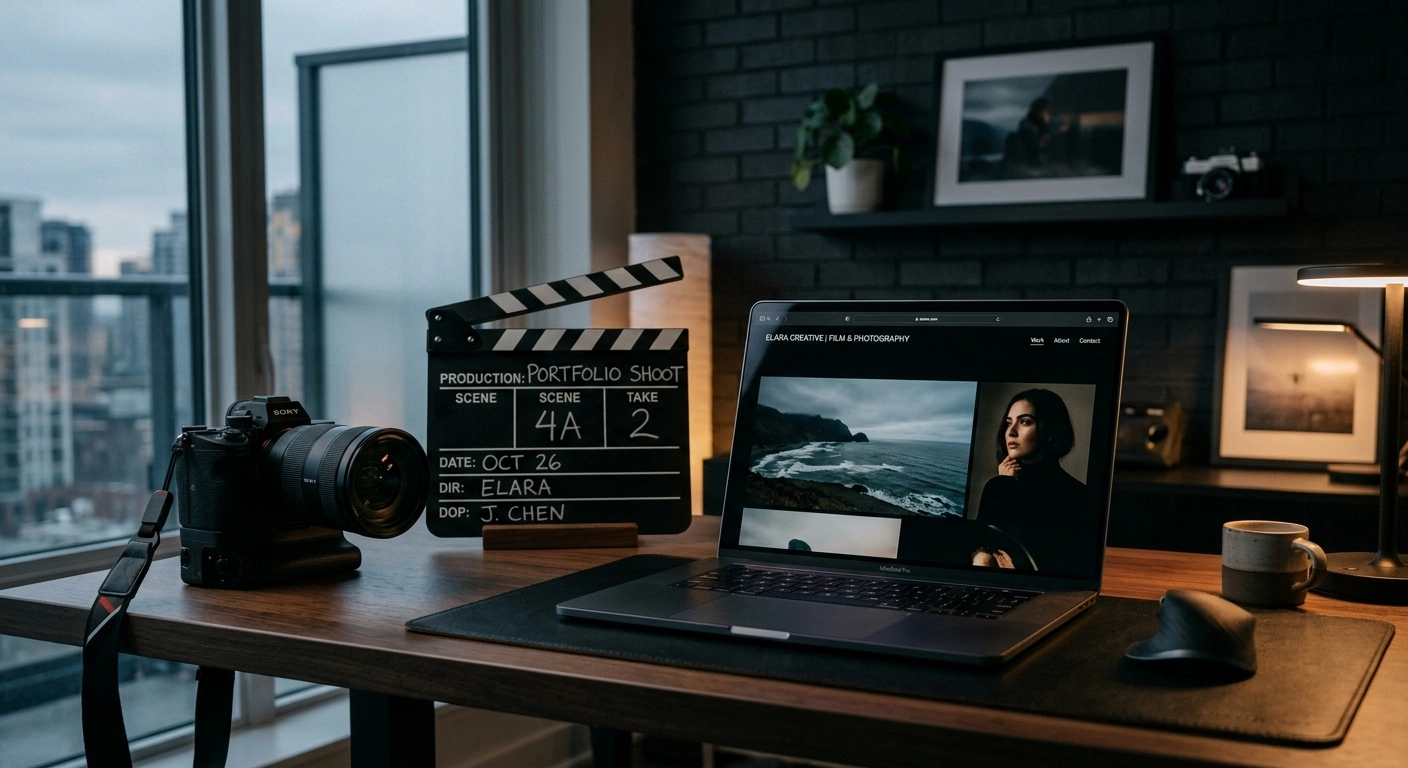
You have built a body of work that deserves to be seen. Your Instagram grid looks immaculate, your reel gets saves, and your inbox fills up — occasionally — with compliments. But when a serious client asks to see your portfolio, you send them an Instagram link. And somewhere in that gap between your talent and that link, you lose them.
In 2026, a custom portfolio website is no longer a luxury reserved for photographers with global clients or filmmakers with award nominations. It is the baseline expectation of any creative professional who wants to be taken seriously. In this article, we break down exactly why Instagram cannot replace a dedicated portfolio site — and what a properly built creative website does that no social platform ever will.
The Problem With Relying on Instagram as Your Portfolio
Instagram was built to capture attention in a scroll, not to convert a high-value client in a boardroom. When a brand manager, creative director, or wedding planner evaluates your work, they are not looking for likes — they are looking for confidence. They want to know that you are a professional who takes their business seriously. An Instagram profile, no matter how well curated, communicates the opposite of that in three immediately visible ways.
First, it puts your work inside a platform designed to distract. Every competitor, every sponsored post, every notification competes for your prospective client's attention the moment they land on your profile. Second, it gives you zero control over the experience — the layout is fixed, the branding is Instagram's, and the context is social, not professional. Third, and most critically, it hands the algorithm control over which of your work actually gets seen. Your best images may be buried three years deep while your most recent but least representative work sits at the top of the grid.
Your portfolio is not just a collection of images or videos. It is the first pitch you make to every client who has never met you. The medium you choose to deliver that pitch tells them as much about your professionalism as the work itself.
Peak Web Craft — Portfolio Website Strategy, 2026
What a Custom Portfolio Website Does That Instagram Cannot
A purpose-built portfolio website is a controlled environment where every decision — from the typeface to the image sequence to the loading animation — is made in service of one goal: convincing the right client that you are the right person for the project. Here is what that control actually makes possible.
It Establishes You as a Brand, Not Just a Creator
The photographers and filmmakers who command the highest rates are not just talented — they are perceived as having a distinct creative identity. A custom website is the single most powerful tool for communicating that identity. Your domain name, your colour palette, your typography, your navigation structure, your bio — every element works together to build an impression that a social media grid simply cannot replicate. When Jugal Shah approached us for his photography and videography portfolio, the brief was clear: the website had to feel as cinematic as his work. The result — a GSAP-powered masonry gallery with a custom ambient lightbox — does not just display his photographs, it frames them with the same intention he brings to every shoot.
It Organises Your Work With Intent
Not all of your work speaks to the same client. A photographer who shoots both corporate headshots and destination weddings has two very different audiences — and showing a wedding planner your LinkedIn portrait session is a conversion mistake. A custom website lets you create dedicated galleries or vaults for each category of work, so every visitor sees exactly the body of work most relevant to what they need. When we built Sheehan Suthar's filmmaker portfolio, we separated his photography and videography into two distinct vaults — a deliberate structural decision that made the entire experience feel intentional rather than random. Clients who arrived looking for a cinematographer saw cinematography. Nothing else diluted that focus.
It Gives You Full Control Over Your SEO
Instagram does not rank in Google for terms like "wedding photographer Ahmedabad" or "commercial filmmaker Mumbai." Your portfolio website can — and with the right technical architecture, it will. JSON-LD structured data, targeted page titles, alt-text strategy, and location-based keyword targeting are all tools available to a custom website that are completely inaccessible on a social platform. For creatives who want inbound enquiries — clients who find them without a referral or cold outreach — SEO is the single highest-leverage investment they can make. A well-optimised portfolio website works for you at midnight when you are asleep and at noon when you are on a shoot.
It Converts Interest Into Enquiries
Instagram gives an interested client one option: send a DM. A custom portfolio website gives them a professional contact form, a clearly articulated services section, an about page that builds personal connection and credibility, and a call-to-action that guides them toward the specific next step you want them to take. The difference between a DM and a completed contact form is the difference between a casual expression of interest and a qualified lead. The latter signals serious intent — and it is far easier to close.
Pro Tip: Google your own name right now. What appears on the first page of results? If your portfolio website is not the first result — or does not exist at all — you are invisible to every client who searches for you after a referral. A custom domain ranks for your name in weeks, not months.
The 5 Things Every Creative Portfolio Website Must Have
A portfolio website that merely exists is only marginally better than no portfolio at all. To perform — to actively bring you clients and raise your perceived value — a creative portfolio must be built around five non-negotiable elements.
- A hero section that communicates your niche immediately. Visitors should know within three seconds whether you are a wedding photographer, a commercial filmmaker, a fine art painter, or a brand photographer. Generic taglines like "Capturing Moments" tell a prospective client nothing. Specific positioning like "Cinematic Wedding Films for Luxury Venues Across India" tells them everything they need to decide if you are the right fit.
- Curated galleries, not complete archives. More work is not better work. A gallery of fifteen exceptional images is vastly more persuasive than a gallery of two hundred. Clients judge your ceiling by your best work and your consistency by your worst. Ruthless curation is the most underrated skill in portfolio strategy.
- An about page that builds trust, not just biography. The about page is the second-most visited page on any creative portfolio. Clients use it to decide if they can work with you as a person — not just hire you for your skill. Tell them your creative philosophy, your process, and the kind of projects you are built for. Make them feel like they already know you before they send an enquiry.
- A contact page that reduces friction to zero. A short, focused contact form with three to five fields performs better than a long questionnaire. Every additional field is a reason for a hesitant client to close the tab. Ask for a name, an email, the type of project, and a budget range — nothing more until you have them on a call.
- Performance that matches the quality of your work. A slow portfolio website actively undermines the impression your work creates. If your images take four seconds to load, the client's first experience of your aesthetic is impatience — not admiration. Image optimisation, lazy loading, and a lightweight codebase are not optional technical details. They are part of your brand.
Portfolio Websites for Different Types of Creatives
The structure and aesthetic of a portfolio website should be tailored to your specific creative discipline. What works for a commercial photographer is not what works for a filmmaker — and neither of those is what works for a fine artist or an illustrator. Here is how the requirements differ by creative type.
Photographers
For photographers, the website is the work. Every layout decision — grid density, image aspect ratio, white space, transition speed — either elevates or diminishes the photographs it contains. Masonry grids work exceptionally well for editorial and documentary photography, where variety in composition is part of the aesthetic. Full-bleed horizontal layouts work better for landscape and architectural photography, where scale and atmosphere are the primary language. The lightbox experience — how an image opens, how it fills the screen, how the navigation between images feels — is as important as the images themselves. We built this level of intentionality into the Jugal Shah portfolio, where a custom ambient lightbox immerses the viewer in each photograph rather than simply displaying it.
Filmmakers & Videographers
A filmmaker's portfolio lives and dies on reel quality — but how that reel is presented matters as much as its content. Autoplaying a heavily compressed video on a cluttered page is a worse first impression than a static frame with a deliberate play button. Filmmakers also benefit from separating their work by discipline: narrative, commercial, documentary, music video, and photography should each live in its own section rather than being mixed into a single feed. A dark, high-contrast visual language — as we used in Sheehan Suthar's portfolio — communicates cinematic intent before a single frame of video plays. The design primes the viewer for the quality of what is coming.
Fine Artists & Illustrators
For fine artists, the portfolio must bridge two worlds: the physical texture and intimacy of traditional work, and the clarity and accessibility of a digital medium. Overcrowded layouts destroy the contemplative quality that fine art requires. Generous white space, high-resolution image handling, and considered typography are the tools that communicate the seriousness of the practice. For Dharmistha Suthar's fine art portfolio, we built a minimalist digital gallery that honours the quiet power of her work — a design that feels closer to a museum catalogue than a social media grid, while remaining warm and accessible to new collectors discovering her for the first time.
Custom Build vs Portfolio Platforms: What You Are Actually Choosing Between
The most common alternative creatives consider is a portfolio platform — Squarespace, Format, Cargo, or Adobe Portfolio. These platforms are not bad. They are simply limited in ways that matter more as your career grows. Here is the honest comparison.
What Portfolio Platforms Do Well
They are fast to set up. They handle hosting. Their templates are clean and functional. For a creative at the beginning of their career who needs a web presence today at minimal cost, a platform like Squarespace is a perfectly reasonable starting point. There is no shame in starting there.
Where They Fall Short
The moment you need your website to behave in a way the template was not designed for — a custom gallery interaction, a specific animation, a non-standard layout — you hit a wall. You are also paying a monthly subscription indefinitely for a site you do not own and cannot export. Your SEO is constrained by the platform's architecture. Your loading performance is dependent on the platform's infrastructure. And most critically, every competitor on the same platform has access to the same template — which means no matter how well you curate your work, the container it lives in looks identical to theirs.
A custom-built portfolio website eliminates all of these constraints. You own the code. You own the design. You own the domain and the SEO equity it accumulates over time. The investment is higher upfront — but it is a one-time investment in an asset, not a recurring fee for a rental.
Pro Tip: Before you brief any developer on a portfolio website, collect five to ten reference websites from creatives in your discipline whose online presence you admire. Do not copy them — use them to articulate what "right" looks like to you. The clearer your brief, the closer the final result will be to your vision.
Wrapping Up
Your work is worth more than an Instagram grid. Every time a high-value client searches for a creative professional in your discipline and finds only a social media profile — or nothing at all — that is a missed opportunity with a real financial cost. A custom portfolio website does not just display your work. It frames it, contextualises it, builds trust around it, and guides the right clients toward the next step.
At Peak Web Craft, our Portfolio Website service is built specifically for photographers, filmmakers, fine artists, and creative agencies who refuse to let their work be undersold by a generic template. We bring the same cinematic intentionality to your website that you bring to your work. If you are ready to build a portfolio that reflects the quality of what you create, let's start a conversation. We are currently accepting new projects and typically respond within 24 hours.