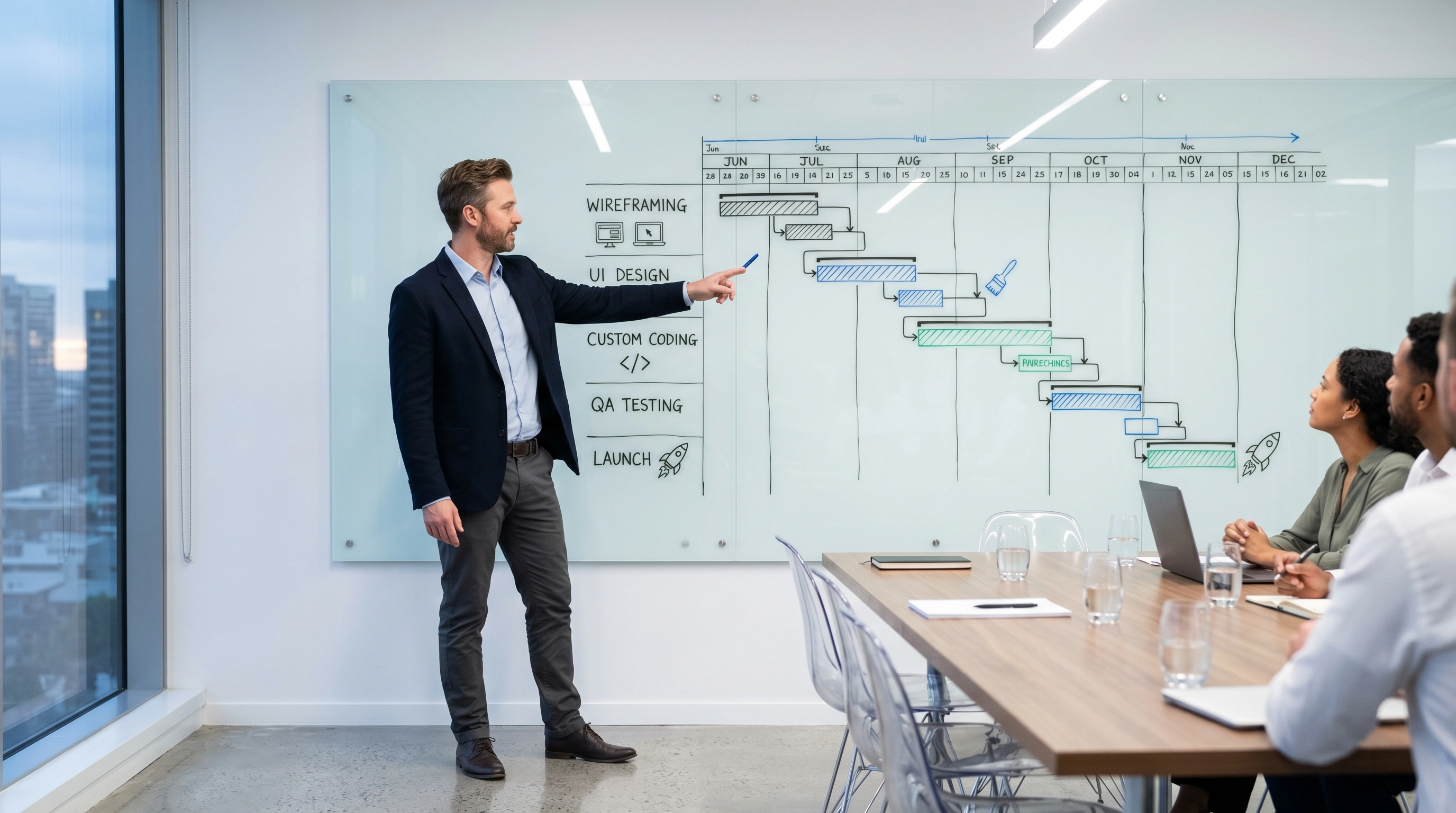
"How long will my website take?" is the single most common question every business asks before initiating a web development project. It is a completely fair query. As a business owner, you need to coordinate your marketing launches, announce new product releases, sync your sales teams, and allocate capital effectively.
However, if you ask three different web design agencies this question, you will likely get three wildly conflicting answers: *one week, two months, or six months.*
This lack of transparency exists because website projects vary dramatically in complexity, scope, and process. In this detailed guide, we demystify the **web development project timeline** in 2026. We will break down realistic turnaround times by project type, dive deep into the five phases of the design and build process, expose the bottlenecks that cause projects to stall, and outline exactly how Peak Web Craft leverages optimized processes to deliver premium, hand-crafted websites on schedule.
Why Website Timelines Vary So Much
A website is not a generic, off-the-shelf product. It is an interactive, digital home custom-built for your brand's unique business goals. Asking how long it takes to build a website is a lot like asking, "How long does it take to build a house?" A pre-fabricated cabin is assembled in days, a standard residential house takes a few months, and a custom architectural mansion can take years.
In web engineering, timelines are primarily dictated by three factors:
- Functional Complexity: A static page displaying text and images requires far less engineering than a booking platform equipped with SMS notifications, API integrations, and multi-currency payment gates.
- Platform & Tech Stack: Drag-and-drop page builders can be thrown together quickly (but are slow, insecure, and visually generic). Conversely, custom, high-performance hand-coded architectures require meticulous engineering, resulting in superior speed, safety, and brand aesthetics. We explore these differences in our detailed analysis of WordPress vs Custom Websites in 2026.
- Content Readiness: A project cannot progress if the development team is waiting for the client to provide copy, high-res team photography, brand guidelines, or product descriptions. This is the single biggest cause of project delays globally.
Timeline by Project Type: What to Realistic Expect
To give you a practical baseline, we have categorized the most common web projects along with their typical **website design turnaround time in India** and globally, based on our studio's real project data.
| Project Type | Typical Timeline | Core Complexity / Deliverables |
|---|---|---|
| Conversion Landing Page | 1 – 2 Weeks | Single, long-form layout, focused CTA, sub-second speed, lead capture forms, CRM integration. |
| Standard Business Website | 3 – 5 Weeks | 5–10 structured pages (Home, About, Services, Case Studies, Contact), full branding integration, custom UI. |
| Interactive Booking Website | 4 – 6 Weeks | Calender integrations, user registration, real-time scheduling slots, automated SMS/email alerts, payment gates. |
| Ecommerce E-Shop (Custom/Shopify) | 6 – 10 Weeks | Catalog management (50+ items), shopping cart, customer checkout portals, coupon systems, secure inventory sync. |
| Bespoke Custom Web Application | 10 – 16+ Weeks | Tailored software dashboard, database queries, client dashboards, heavy API integrations, custom Node/React backend. |
1. High-Converting Landing Pages (1 to 2 Weeks)
A landing page has one singular goal: driving a specific user action (e.g., booking a demo, signing up for a webinar, or downloading an ebook). Because it is a single-page structure, the timeline is tight.
* **How long a landing page takes to build**: Typically 7 to 10 business days. * **Why it is fast**: Design is highly focused, content is concise, and database architecture is minimal. The engineering focuses on conversion rate optimization, sub-second visual performance, and connecting form fields directly to your company's CRM or email automation system.
2. Premium Corporate & Business Websites (3 to 5 Weeks)
This is the classic multi-page informational platform built for professional service providers, consulting agencies, local businesses, and modern enterprises.
* **How many weeks to launch a business website**: 3 to 5 weeks. * **What is involved**: We design and code a custom structure containing a high-converting Homepage, a brand-elevating About page, dedicated Service pages, a portfolio or Case Studies section, an active SEO Blog catalog, and a direct Contact portal. The timeline includes tailored UI layouts, mobile optimization across all viewport heights, and full search engine setup.
3. Booking & Service-Scheduling Portals (4 to 6 Weeks)
If your business depends on appointments—such as medical practices, legal firms, consulting studios, car rentals, or luxury salons—your website is a functional business hub.
* **Typical booking website timeline**: 4 to 6 weeks. * **What adds time**: Engineering real-time availability calendars that sync seamlessly with your team's Google or Outlook calendars, integrating secure online deposit payment gates (Stripe, Razorpay), setting up automated customer notification profiles (SMS and Email reminders), and programming customer account dashboards.
4. Full-Featured Ecommerce Stores (6 to 10 Weeks)
Ecommerce sites are highly interactive networks. You are handling transaction histories, financial processing, database calls, dynamic inventory changes, shipping tax calculations, and localized currencies.
* **How long to build an ecommerce website**: 6 to 10 weeks. * **Why it takes longer**: Building catalog pages, dynamic search filtering, shopping carts, automated shipping slips, inventory tracking systems, tax calculation modules, customer loyalty accounts, and conducting rigorous checkout security audits. Choosing the right foundation is critical; we weigh the options in our Shopify vs WooCommerce vs Custom Ecommerce comparison.
The 5 Phases of Web Development and How Long Each Takes
A professional digital studio does not simply sit down and start writing code on Day 1. Fulfilling elite design and development standards requires a structured, phase-based methodology. Below are the five distinct phases of a modern web development project.
Phase 1: Planning, Research & Wireframing (1 Week)
Before designing a single card, the agency must define the site map, map out the user pathways, analyze competitor sites, and clarify the technical parameters.
* **Timeline**: 5 to 7 days. * **Deliverables**: Technical requirements, sitemap schema, low-fidelity wireframe skeletons, and a unified project brief. We provide a complete roadmap for this stage in our Website Project Brief Template and Guide.
Phase 2: High-Fidelity UI/UX Design (1 to 2 Weeks)
This is where the visual aesthetics come to life. The design team builds custom layout mockups showing exact color systems, typography combinations, image placements, and interactive hover states.
* **Timeline**: 7 to 14 days. * **Process**: Collaborative design feedback loops. You are presented with live Figma files or mockups to review exactly how your site will look before a single line of code is committed.
Phase 3: Front-End & Back-End Engineering (2 to 4 Weeks)
This is the core execution stage. Front-end engineers convert the approved Figma designs into clean, responsive HTML, CSS, and lightweight JS. Back-end developers construct the databases, program the CMS (Content Management System), set up server settings, and integrate external APIs.
* **Timeline**: 14 to 30 days. * **Process**: Writing standards-compliant, modular, highly secure, and performance-optimized code. A heavy emphasis is placed on ensuring the code is exceptionally lightweight to deliver sub-second speeds.
Phase 4: Quality Assurance & Cross-Browser Testing (3 to 5 Days)
A premium site must look and function flawlessly on every screen size, browser, and device.
* **Timeline**: 3 to 5 days. * **Testing checklist**: Running scripts to check for broken internal links, verifying mobile-first touch targets, verifying SSL certificates and form submission security layers, testing compatibility across Safari, Chrome, Edge, and Firefox, and measuring PageSpeed scores to optimize assets.
Phase 5: Launch, Indexing & Handover (2 Days)
The final step is pointing your domain to the production servers, setting up CDN (Content Delivery Network) caching, submitting your sitemap directly to Google Search Console for rapid indexing, and training your internal team on how to update content.
* **Timeline**: 2 days. * **Deliverables**: Live website launch, CMS tutorial recordings, backup configurations, and ongoing maintenance handoff.
What Slows Projects Down — and How to Avoid It
Almost every web project that misses its launch date does so due to predictable bottlenecks. By understanding these issues upfront, you can save weeks of development time.
- Client Content Delays: Waiting for copy and photos is the #1 reason websites stall. * *The Fix*: Start writing your copy and capturing your branding photos *during* Phase 1 and 2. Alternatively, hire a studio that offers professional copywriting and asset-sourcing services to keep things moving.
- Unclear Scope & "Scope Creep": Requesting major new features mid-way through development (e.g., adding a client portal to a business website that is already 80% coded). * *The Fix*: Spend time during the planning phase to finalize your exact feature checklist. Let the primary site launch first; secondary features can be rolled out as post-launch upgrades.
- Slow Feedback Loops: If the agency submits a design mockup on Monday, but the client takes 10 days to review and send feedback, the project team's momentum is broken. * *The Fix*: Assign a single internal decision-maker on your team to manage the website project. Commit to providing unified feedback within 48 hours of design submittals.
Can You Get a Website Built Faster?
Yes! If you are facing a strict market deadline (e.g., an upcoming investor presentation, trade show event, or advertising campaign), a website can be built under an accelerated schedule. This is often referred to as **rush website development in India** and globally.
To execute a rush project successfully, several structural adjustments are made:
- Staged Launch: Launch a beautiful, single-page "Coming Soon" or high-converting Landing Page first. This establishes your online presence instantly. The remaining service pages can then be developed and deployed sequentially behind the scenes.
- Prepared Assets: You must have your high-res branding kit, finalized text copy, team photography, and domain registration fully prepared and organized on Day 1.
- Dedicated Developer Allocation: The agency assigns dedicated, full-time developers exclusively to your project, accelerating coding schedules by running concurrent design and engineering tracks.
How PeakWebCraft Manages Timelines with Absolute Precision
At Peak Web Craft, we do not believe in vague timelines or "estimated guesses." We treat project deadlines as critical business commitments. We maintain a **100% on-time launch rate** by utilizing a strict, highly transparent process:
- Real-Time Project Dashboards: When we kick off your project, you receive access to a dedicated client portal showing real-time progress, upcoming milestones, and explicit due dates for both our team and yours.
- Component-Driven Custom Coding: We do not use bloated page-builders that break or lag. We leverage our proprietary, highly optimized modular CSS and HTML foundations. This allows us to code stunning, responsive custom websites with unparalleled speed without sacrificing premium craftsmanship.
- Pre-Production Speed Checklists: We conduct rigorous testing across all Core Web Vitals targets from the very first line of code, ensuring that your launch day is completely frictionless.
FAQs
Frequently Asked Questions
Q1: How fast can Peak Web Craft build a custom website if I have a rush deadline?
For urgent market launches, we can design, engineer, and deploy a fully custom, high-converting Landing Page in as little as 5 to 7 days, or a streamlined 5-page Business Website in 12 to 14 days, provided all copy assets and branding materials are prepared and delivered to us on Day 1.
Q2: What is the single biggest cause of website delays?
Without question, the biggest cause of project delays is client-side content delivery. Gathering professional copy, organizing high-resolution product photography, and coordinating internal team reviews often takes businesses far longer than expected. Having these assets organized early dramatically shortens the development cycle.
Q3: Will my website be usable during the redesign process?
Absolutely. We build all our redesigns and new custom layouts on our private, secure staging servers. Your existing live website remains completely functional and online for your customers. Only when you have reviewed, tested, and fully approved the new staging site do we execute the 10-minute migration to push the new build live.
Let's Build Your Digital Headquarters on Schedule
A beautiful website is only valuable if it actually launches. Partnering with a professional studio that respects deadlines, maintains complete process transparency, and writes elite, lightweight code is the key to ensuring your digital investment is delivered on time, within budget, and built to perform.
If you have an upcoming launch or want a realistic, tailored timeline and pricing breakdown for your upcoming project, get in touch with the Peak Web Craft team today. Let's discuss your launch goals and build a precise plan to achieve them.