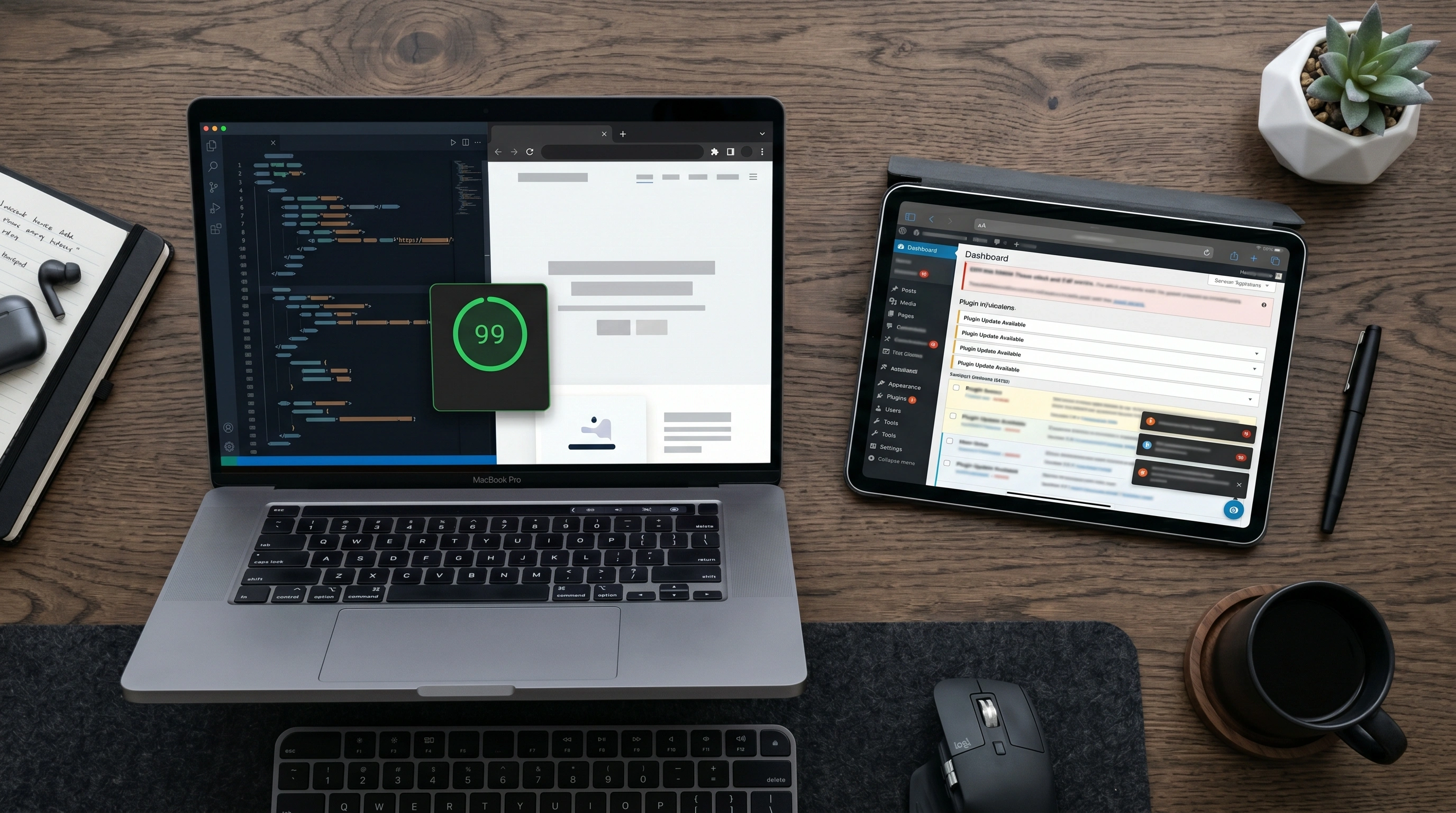
When deciding to build a new business website, one of the first and most critical decisions you will make is choosing your technology path. Most business owners find themselves staring down a major fork in the road: should we build a website on WordPress, or should we invest in a custom-coded, hand-crafted site?
In 2026, this choice is more critical than ever. As Core Web Vitals, dynamic accessibility standards, advanced security threats, and complex customer journeys define online business, selecting the wrong platform can leave your brand behind. This guide is designed to cut through the marketing noise and give you a raw, honest comparison between a template-built WordPress site and a custom-engineered web asset. We will break down setup costs, ongoing maintenance, SEO architecture, speed metrics, and security considerations so you can make the absolute right choice for your company's future.
What is a WordPress Website?
Originally launched in 2003 as a simple blogging platform, WordPress has grown to power more than 40% of all websites on the internet. In its essence, WordPress is an open-source Content Management System (CMS) built on a database-driven framework of PHP and MySQL.
For most standard businesses, a "WordPress site" means using pre-built themes (such as Astra, Divi, or Avada) combined with page builders (like Elementor or WP Bakery) and a stack of third-party plugins to add functionality. Because it uses a graphical user interface, it allows non-technical users to edit text and upload media without touching code.
However, this convenience comes with severe structural trade-offs. Because WordPress is built to be a one-size-fits-all solution for millions of users, its core codebase, themes, and plugins contain massive amounts of unused code. This overhead leads to slow rendering speeds, plugin compatibility conflicts, database bloat, and a fragile architecture that can break during standard updates.
What is a Custom-Built Website?
A custom-built website is an entirely bespoke digital product. It is designed from scratch in design systems like Figma and then translated into hand-coded semantic markup using modern, optimized web languages (HTML5, CSS3, and modern ES6+ Javascript). It does not rely on a monolithic CMS database to render simple, static pages.
At Peak Web Craft, we approach custom development with an engineering-first mindset. Every single line of code is written specifically for your project. There are no templates, no heavy graphical page builders, and no bloated third-party plugins. Instead, we use clean architecture, modern component libraries, and optimized server pipelines to create lightweight assets that load instantaneously.
For dynamic components, like blogs, product inventory, or appointment bookings, custom sites are paired with modern, decoupled database architectures or serverless backends (such as Supabase, Flask, or Headless APIs). This guarantees that your site remains fast, incredibly secure, and perfectly tailored to your exact business operations.
WordPress vs Custom: 8-Point Side-by-Side Comparison
To help you visualize how these two development paths stack up against each other across core operational metrics, we have put together a comprehensive comparison table below:
| Metric | WordPress Website (Template & Builder) | Custom Hand-Coded Website |
|---|---|---|
| 1. Page Loading Speed | Slow to average due to unused CSS, JS bloat, and database queries. | Sub-second (instantaneous) load times via optimized, clean assets. |
| 2. Security Vulnerability | High risk. Common target for automated exploits via outdated plugins/themes. | Extremely Secure. Zero database exploits, no plugin entry points. |
| 3. Design Flexibility | Restricted to theme limitations and grid constraints of builders. | Infinite. Bespoke interface aligned precisely with your brand. |
| 4. Core Web Vitals (SEO) | Difficult to optimize due to layout shifts (CLS) and blocking scripts. | 100/100 Mobile Scores by default. Fast, clean rendering paths. |
| 5. Maintenance Overhead | High. Requires weekly plugin, theme, and core PHP version updates. | Near-Zero. No dependencies that break or expire. |
| 6. Long-term Scalability | Hard to scale. Adding complex portals requires custom coding over a legacy CMS. | Highly Modular. Can easily integrate with API services and custom apps. |
| 7. Database Performance | Slows down over time due to post revisions, options tables, and queries. | Ultra-Fast. Minimal or serverless queries engineered for speed. |
| 8. Cost of Development | Lower upfront cost, but carries high long-term maintenance fees. | Higher upfront investment, with very low recurring costs. |
When Should You Choose WordPress?
Despite its structural limitations, WordPress is still a viable option for certain situations. You should consider using WordPress if:
- You have a very tight budget: If your budget is extremely limited (under ₹8,000) and you need a basic personal website, you can use a cheap pre-made theme to launch quickly.
- You publish high-volume content daily: If your primary business is media, news, or a multi-author blog with dozens of content contributors uploading articles multiple times a day, WordPress’s core editor is designed for this layout.
- You want to manage your own layout changes: If you prefer using page-builders to frequently drag, drop, and rearrange layout rows without a developer’s help, a builder framework gives you that visual environment.
When Does a Custom Website Make More Sense?
For established businesses, professional service providers, ambitious startups, and high-ticket service companies, a custom website is almost always the smarter, higher-yield investment. Custom web design is the right choice if:
- Performance & Google Rankings are Critical: If your business relies on organic traffic to generate leads, your site must load instantly and achieve perfect Core Web Vitals. Custom builds are engineered to rank higher natively. Learn more on our Business Website service page.
- You Want to Stand Out Visually: If your business operates in a highly competitive market, a generic template signals that you are just like everyone else. Custom-built layouts feature premium typography, custom GSAP scroll-triggered animations, and a sleek modern visual identity that establishes massive brand authority. Visit our Portfolio Website page for visual examples.
- You Need Custom Operations & Integrations: If your business requires custom scheduling engines, booking forms, multi-tenant databases, or complex payment flows (e.g. clinic booking, customized ecommerce checkout, client portals), a custom layout is far superior. Check out our Booking Website service and our Custom Web Apps service to see how we build robust client workflows.
- Security and Stability are Vital: If your site captures sensitive customer data, handles transactions, or acts as a vital utility that cannot afford to go offline or get hacked, a secure, hand-coded build gives you complete peace of mind.
"A website is not merely a digital flyer — it is the permanent digital headquarters of your brand. When you use cheap, slow templates, you are quietly signaling to your highest-value clients that your business isn't premium."
Peak Web Craft — Design Architecture Principles
The Hidden Costs of WordPress No One Tells You About
Low-cost freelancers and agencies often pitch WordPress as a cheaper option because they can build it quickly using drag-and-drop tools. What they don't tell you is the high long-term price of ownership. Here is a breakdown of the hidden costs that standard WordPress sites carry:
- Premium Plugin Subscriptions: Page builders, form builders, SEO plugins, security suites, backup utilities, caching engines, and speed boosters often require premium licenses costing between ₹3,000 to ₹15,000 per plugin, per year.
- High Maintenance Retainers: Because plugins, themes, and PHP databases require regular updates, they regularly conflict with each other. If you don't update them, your site becomes highly vulnerable to hackers. If you do update them, sections of your site can break. You end up paying developers ₹2,000 to ₹5,000 monthly just to keep the site stable.
- Premium Hosting Requirements: To make a bloated WordPress theme load reasonably fast, you cannot use basic hosting. You are forced to pay for expensive managed WordPress hosting (₹1,500 to ₹4,000/month) to run high-performance caching layers. In contrast, a custom HTML/CSS site is so lightweight that it can be hosted on premium global CDN edge networks for near-zero cost.
- The Cost of Poor Conversion: If your website takes 4 seconds to load instead of 1 second, you are losing up to 40% of your visitors before they even see your homepage. If you are running paid Google or Meta Ads, you are effectively burning your ad budget on traffic that bounces due to performance.
Real-World Examples & Case Studies
Let’s look at a concrete case study from our project vault.
Our client, Jugal Shah, a premium photographer and filmmaker, needed a digital showcase that looked as artistic and premium as his visual work. Initially, he attempted to use a standard WordPress theme with Elementor. The site was sluggish, layout configurations broke on mobile screens, and the heavy image galleries took seconds to load, resulting in a terrible user experience for prospective clients who wanted to review his work quickly.
We rebuilt his entire portfolio from the ground up as a custom static asset. By using optimized WebP images, clean CSS masonry grids, custom ambient lightboxes, and smooth GSAP-powered cinematic animations, the new site loaded in under 0.6 seconds. The result? A massive boost in page-views, perfect mobile compatibility, and an immediate increase in premium bookings. This demonstrates the immense business value of custom engineering over generic templates.
FAQs
Frequently Asked Questions
Q1: Can I convert my existing WordPress site into a custom website?
Yes. We regularly take content, copy, and layout structures from old, slow WordPress sites and re-code them from scratch into premium, high-speed custom sites. You keep your domain name, page URLs, and organic rankings, while gaining massive performance boosts.
Q2: How will I edit text on a custom-built website?
We pair our custom builds with modern, lightweight headless Content Management Systems or visual editors that do not slow down your front-end code. This allows you to easily edit text, add team members, or post new blog articles through a secure admin portal, while the client-facing site remains ultra-fast.
Q3: Is WordPress really that insecure?
WordPress itself is reasonably secure, but because it is open-source and popular, hackers write automated bots to scan sites for known plugin vulnerabilities. If your site uses a typical stack of 15 to 25 plugins and you don't update them weekly, it is highly vulnerable to code injections and malicious redirects.
The Bottom Line
WordPress is a popular tool for building fast brochure websites on a shoestring budget. But if you view your website as a serious business asset designed to build long-term brand equity, rank on search engines, run paid campaigns, and generate revenue, a premium custom-built site is the smarter, more cost-effective choice over its lifetime.
If you are ready to build a fast, secure, and visually stunning digital home for your brand, contact the Peak Web Craft team today. We will analyze your goals, outline a clear, transparent scope of work, and build an asset engineered to perform.