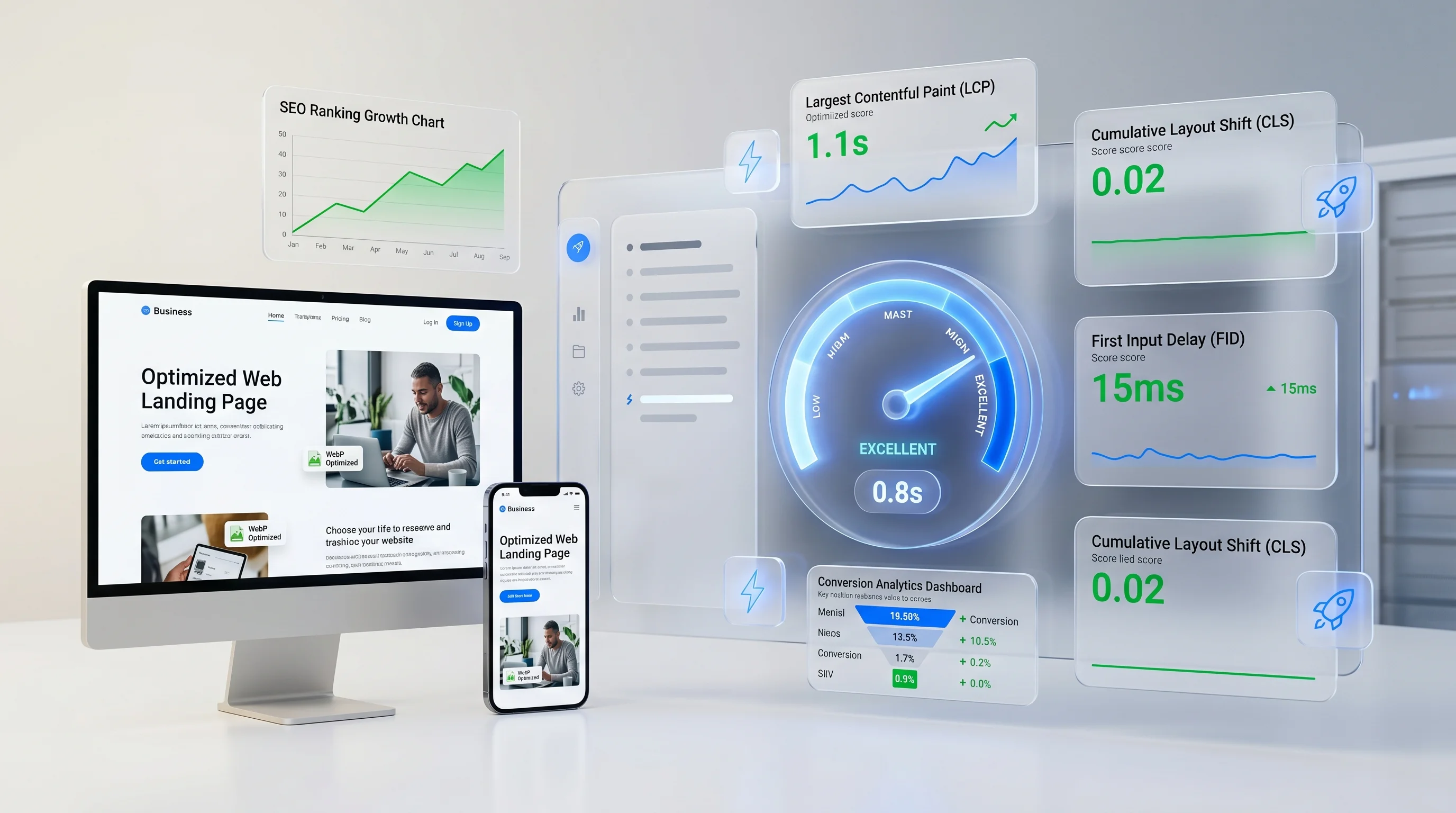
Website speed is one of the clearest examples of a technical detail becoming a business result. A slow website hurts search visibility, frustrates mobile users, reduces trust, wastes paid traffic, and lowers conversion rates. A fast website does the opposite: it helps visitors move smoothly from interest to action.
For modern businesses, speed is not a final polish item. It should influence design, development, hosting, image handling, scripts, fonts, analytics, and content from the beginning of the project.
Why Website Speed Matters for SEO
Google wants to send users to pages that answer the search query and provide a good experience. Speed is part of that experience. While content relevance and authority still matter most, performance can affect how users behave after they land on the page and how Google evaluates page experience through metrics like Core Web Vitals.
Core Web Vitals connect speed to user experience
Core Web Vitals measure loading performance, interaction responsiveness, and layout stability. In plain terms: how quickly the main content appears, how responsive the page feels, and whether things jump around while loading. A website can look beautiful in a design file and still perform badly if these metrics are ignored.
Faster pages improve crawl efficiency
Search engines have limited resources when crawling websites. Fast, clean pages are easier to crawl and index. For small websites, this may be subtle. For larger blogs, ecommerce stores, and service websites with many pages, technical efficiency becomes more important.
How Speed Improves Conversions
Conversions depend on momentum. When someone clicks your website from Google, Instagram, an ad, or WhatsApp, they have intent. Slow loading interrupts that intent. Every delay creates a small moment of doubt: Is this business professional? Is the website broken? Should I try another result?
Fast websites feel more trustworthy
Users may not describe a site as technically optimized, but they feel the difference. A fast website feels modern, reliable, and easier to work with. A slow website makes even a strong business look careless.
Speed protects paid marketing budgets
If you run Google Ads, Meta Ads, or LinkedIn campaigns, every click has a cost. Sending paid traffic to a slow landing page means paying for visitors who may leave before seeing the offer. Faster landing pages make ad spend more efficient because more visitors actually reach the message and CTA.
The Most Common Causes of Slow Websites
- Oversized images uploaded directly from cameras or design exports.
- Too many plugins, tracking scripts, chat widgets, and animation libraries.
- Cheap or poorly configured hosting.
- Bloated themes and page builders that load unnecessary code.
- Unoptimized fonts and render-blocking CSS or JavaScript.
- Large videos or background media without proper compression and loading strategy.
Pro Tip: Speed optimization is not one plugin. It is a set of decisions across design, code, content, hosting, images, scripts, and measurement.
Practical Ways to Build a Faster Website
Use the right image formats and dimensions
Images are often the biggest performance problem. Use modern formats like WebP, export images at the dimensions they are displayed, compress them properly, and include width and height attributes to reduce layout shift.
Keep the design focused
Heavy visual effects, multiple sliders, unnecessary videos, and decorative animations can slow down a site without improving conversions. A premium website is not the one with the most movement. It is the one where every section helps the user decide.
Limit third-party scripts
Analytics, heatmaps, chat tools, ad pixels, embedded forms, and social widgets can all slow down a page. Use what you need, remove what you do not, and load scripts carefully.
Choose performance-aware development
Clean HTML, scoped CSS, optimized JavaScript, proper caching, and responsive media handling are easier to build from the start than to patch later. Performance should be part of the website development process, not an emergency cleanup.
Speed Metrics Worth Tracking
- Largest Contentful Paint: how quickly the main content loads.
- Interaction to Next Paint: how responsive the page feels when users interact.
- Cumulative Layout Shift: whether the layout jumps while loading.
- Total page weight: the amount of data a visitor must download.
- Conversion rate by device: whether mobile visitors convert differently from desktop visitors.
FAQ: Fast Loading Websites
What is a good website load time?
Aim for the main content to appear as quickly as possible, especially on mobile. Instead of chasing one universal number, track Core Web Vitals, real mobile performance, and conversion behavior.
Can a visually rich website still be fast?
Yes, if it is designed and built carefully. Rich visuals need optimized assets, disciplined animation, strong layout planning, and performance-aware code.
Final Thoughts
Fast loading websites improve SEO and conversions because they respect user intent. They help visitors stay, read, trust, and act. If your website is slow, every marketing channel becomes less efficient. Peak Web Craft builds business websites, ecommerce websites, and landing pages with performance as a core requirement.