
A. Business websites
Business Website Design for Consultants and Professional Services
Plan business website design for consultants and professional firms around clear expertise, service boundaries, relevant proof and a useful enquiry path.
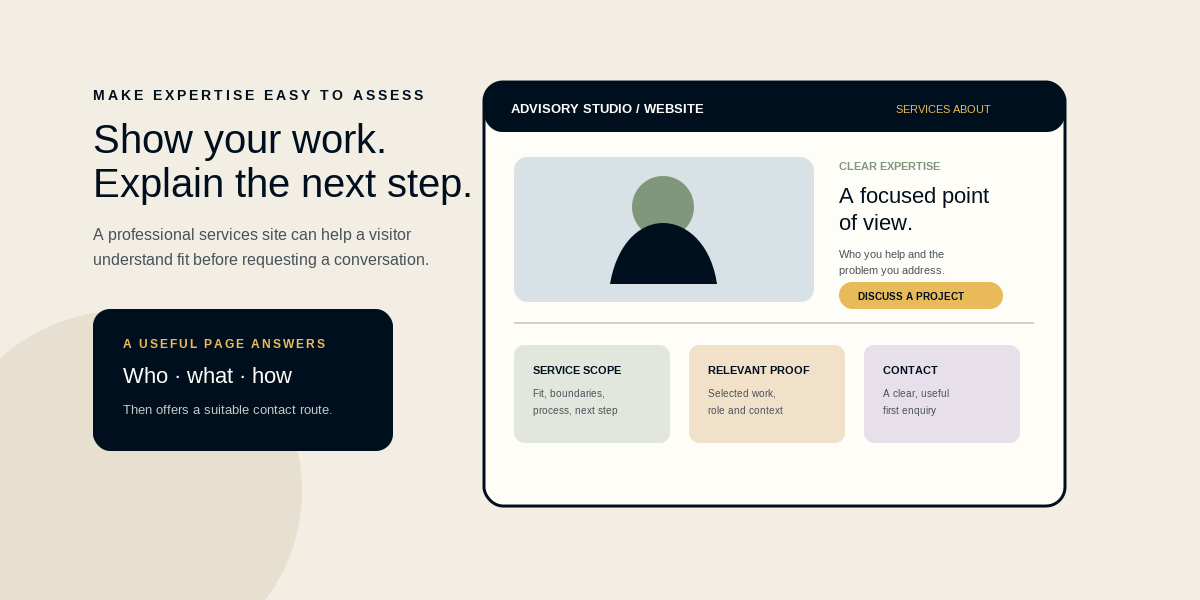
Good business website design for a consultant or professional service makes it easier for a suitable prospect to understand your expertise, assess whether your service fits and choose a next step. Use specific language, relevant evidence and clear service boundaries; avoid a generic design that says little about how your firm helps.
TL;DR
- Describe the client situation, service and fit in plain language before adding design flourishes.
- Use project examples or credentials only when they are relevant, accurate and clearly attributed.
- Explain your process and service boundaries so a prospect can decide whether to enquire.
- Make the contact route and what happens next easy to understand.
Begin with who you help and what they need
A consultant or professional firm often sells expertise that a visitor cannot inspect before working together. The website should make the expertise concrete: name the kinds of problems you address, the people or organizations you serve, and the work involved. Replace broad claims such as “trusted solutions” with specific, verifiable descriptions of your approach.
| Instead of | Clarify |
|---|---|
| We offer end-to-end consulting. | Which decision, workflow or business problem do you help with? |
| We work with every business. | Which organization types or situations are a strong fit? |
| Our experts deliver results. | What relevant work, qualifications or process can you accurately show? |
| Contact us to learn more. | What information should a prospect share and what happens after contact? |
Explain service fit, scope and process
A service page should answer a prospect's practical questions: what is included, what is not included, what information the firm needs, and how the engagement begins. The level of detail should reflect the complexity and risk of the decision. A brief advisory conversation may need less explanation than a multi-stage professional engagement.
- State who the service is for and the situation that usually brings a client to it.
- Explain the work stages, inputs and decisions at a level a prospective client can follow.
- Describe important exclusions or dependencies rather than leaving expectations implicit.
- Give visitors an idea of the next step without promising a specific outcome or response time.
- Use separate service pages when the audience, scope or buying questions materially differ.
This article focuses on positioning and proof for consultants. For a practical inventory of core service-business page types, see what pages a service business website needs.
Use evidence that helps a prospect judge your expertise
Proof can include project stories, named qualifications, relevant team experience, a clear methodology or a sample of the work. Choose evidence that answers a real buyer question. If a case study describes a result, make clear what was measured, who did the work and what other factors may have contributed; do not imply that another client will get the same outcome.
| Evidence | Context to add |
|---|---|
| Project or case study | Client situation, agreed scope, your contribution and any verified outcome. |
| Credentials | Issuing body, relevant specialization and current status where applicable. |
| Process or framework | How it guides the work, what decisions it supports and its limitations. |
| Testimonials | Accurate attribution and permission, with no edited meaning. |
| Team profile | Relevant role, experience and responsibility in the engagement. |
Organize the site around the buying decision
A visitor may move from a service summary to a relevant example, then to a person or process detail before contacting the firm. Navigation should make those relationships clear. Do not force every page to repeat the same value proposition; give each page a distinct purpose and connect related information with descriptive internal links.
- Identify the main client types and questions that bring them to the website.
- Choose service pages that explain distinct offerings or engagement types.
- Connect relevant case studies and team information to the service decisions they support.
- Place contact routes where a visitor has enough context to act.
- Review the mobile reading order so expertise, proof and contact remain accessible.
For the page hierarchy and mobile reading path, use the mobile-first business website planning checklist. The business website service describes custom page architecture, responsive layouts, content workflows where needed and technical search foundations.
Make the first enquiry straightforward and appropriate
A useful enquiry path tells visitors whether they should call, email, submit a form or book a conversation. The form should request enough information for the firm to respond meaningfully without asking for sensitive or unnecessary detail too early. Explain how the submission is handled and provide an alternate contact route when appropriate.
- Label fields clearly and explain which ones are required.
- Ask for a short description of the need only if it helps route or prepare the first response.
- Confirm what a successful submission means and what the visitor should expect next.
- Ensure the destination inbox or CRM is monitored and tested.
- Do not publish response-time claims that the team cannot consistently meet.
Support visitors and search systems with clear, useful content
Write service information for the people who need to assess your firm. Use descriptive headings, accurate page titles, crawlable internal links, useful image descriptions and a clear page purpose. Keep facts consistent across the website and do not add credentials, locations or service claims that are not true.
Google's current AI search guidance says the foundational SEO practices remain relevant: helpful information in text, crawlable internal links and structured data that matches visible page content. It calls for no special schema or wording trick for AI features. See the Google Search Central guide to generative AI search.
Frequently asked questions
What should a consultant's business website include?
Explain who the consultant helps, what services include, relevant expertise or work, how an engagement begins and how a prospect can make contact. Add pages according to distinct buyer questions rather than a fixed page count.
How do I make a professional services website stand out?
Use specific language about your clients and work, show accurate evidence of relevant experience, explain your approach and make service fit clear. Avoid unsupported superlatives or generic claims that could describe any firm.
Should each consulting service have its own page?
Use separate pages when services have different audiences, scopes or decision questions. If the work is closely related, a combined page with a clear hierarchy may be easier to understand and maintain.
What proof can a professional services firm show online?
Relevant project stories, credentials, team experience, methodology or testimonials can help when accurate and properly contextualized. Explain your role and avoid implying that one client's result is guaranteed for another.
How should a consultant website collect enquiries?
Offer a clear contact route and ask only for information needed to respond. Explain required fields, confirm successful submission and ensure the receiving inbox or system is monitored.