
A. Business websites
Website Maintenance Cost in India: What Changes the Quote
Website maintenance cost in India depends on update frequency, backups, monitoring, support expectations and what the provider includes in writing.
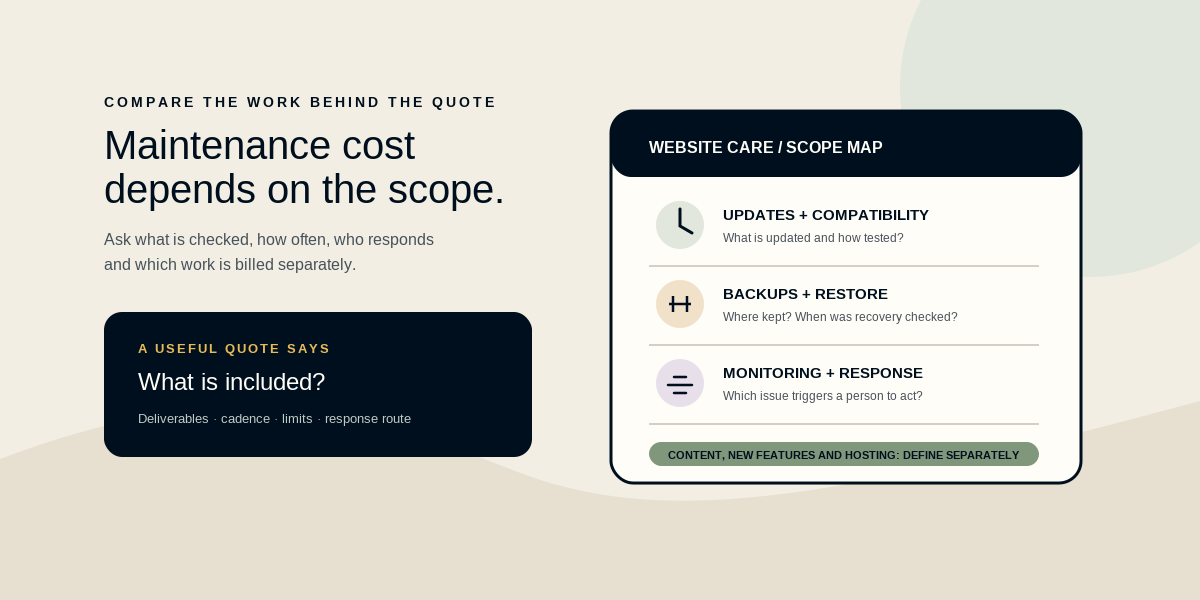
There is no single website maintenance cost in India that fits every site. A quote changes with the platform, update frequency, backup and recovery plan, monitoring, support response, content work and technical changes included. Compare the tasks, limits and accountabilities in each proposal before comparing its monthly or annual total.
TL;DR
- Separate routine care, content edits, hosting and new development into named scope items.
- Check backup retention and restoration responsibility—not only whether backups are mentioned.
- Ask what support hours, response targets, request limits and exclusions apply.
- No fixed maintenance rate is published by Peak Web Craft; confirm current availability and scope directly.
Why website maintenance cost varies
Two websites with the same number of pages may have very different support needs. A mostly static company site has a different update and recovery profile from a store with payments, inventory and order integrations. A CMS used by several editors also needs a different access and change process from a site whose content rarely changes.
If you are comparing providers rather than budgets, see what to expect from website maintenance services in India and how to define the scope.
For that reason, a monthly or annual fee is meaningful only beside a written description of tasks, frequency, response limits and exclusions. A low headline may omit hosting, licences, content edits or out-of-scope development; a higher quote may include work your team does not need. Ask for comparable deliverables rather than assuming one standard India-wide rate.
What changes a website maintenance quote?
| Cost factor | Questions that define the scope |
|---|---|
| Platform and dependencies | Which CMS, plugins, themes, apps, APIs and licences need review or renewal? |
| Update frequency | How often are security, platform or compatibility updates applied and checked? |
| Backups and recovery | What data is backed up, where is it stored, how long is it retained and who tests restoration? |
| Monitoring | Which availability, form, transaction or security events are observed and who responds? |
| Support expectations | What hours, response targets, request limits and escalation path apply? |
| Content and development | Are text changes, new pages, redesigns and new features included or separately quoted? |
| Hosting and third parties | Which hosting, domain, email, licence and provider fees are paid directly or passed through? |
Compare monthly, annual and one-off support clearly
A monthly plan can suit recurring checks or regular requests; an annual agreement may organise planned reviews or renewals; a one-off engagement can address a specific update or repair. The label does not tell you what work is performed. Request the schedule, task record and limits that sit behind the term.
| Arrangement | Clarify |
|---|---|
| Monthly support | Included checks, unused time treatment if relevant, request caps, response windows and cancellation terms. |
| Annual review | Review dates, renewal duties, update cadence and any work that is separately billed. |
| One-off work | Diagnosis, defined outcome, testing, deployment, warranty or correction period and handover. |
| Hosting or platform fee | Provider, term, renewal owner, backup responsibility and what happens if service ends. |
Separate routine maintenance from improvements and new work
Routine maintenance generally concerns preserving the agreed website's expected operation: updates, checks, backup handling or small defined adjustments. Content additions, redesigns, new integrations, custom features, migration and ongoing SEO can require separate discovery and implementation. A proposal should tell you where routine care ends and a change request begins.
- Routine care: identify specific checks, update responsibility, backup scope and records supplied.
- Content edits: define which changes, how many requests and what approval process apply.
- Technical changes: document what counts as a defect correction versus a new feature or compatibility project.
- SEO: distinguish a technical issue fix from research, content planning, implementation and reporting.
- Hosting and accounts: state who pays each provider, controls access and handles service renewals.
If you are still deciding what should be editable or maintained after launch, use the mobile-first small business website checklist to document page owners and update needs before commissioning the build.
A checklist for comparing website maintenance quotes
- List the site, platform, domains, hosting and third-party services covered by the proposal.
- Mark every task as included, excluded or separately chargeable, and note its cadence.
- Ask how backups are retained and how restoration is tested or requested.
- Confirm the support contact, working hours, response target and severity process.
- Check who owns accounts, credentials, renewal payments, code and website data.
- Request the process for access changes, staff departure, plan cancellation and handover.
Also ask whether the quote assumes the site is currently healthy. Existing errors, unsupported dependencies or an undocumented integration may need a separate audit or repair before routine care can be priced responsibly. If a provider offers a very broad promise such as unlimited edits, ask what still requires separate approval.
How Peak Web Craft scopes post-launch responsibilities
Peak Web Craft's business website service describes agreed launch checks, editing guidance, ownership and access information, with third-party licences and continuing support responsibilities documented. It does not publish a standard website maintenance plan or fixed rate. The service page also treats continuing SEO as a separately scoped engagement. See business website development for the current project scope, then confirm whether the specific post-launch work you need can be taken on.
For a new project, a clear brief should identify what your team wants to edit, which vendor accounts it will own and what help might be needed after handover. The web development studio brief checklist helps collect those decisions before a proposal is prepared.
Frequently asked questions
How much does website maintenance cost in India?
There is no single reliable price for every website. Cost depends on the platform and dependencies, update and backup tasks, monitoring, support expectations, content changes, hosting and third-party fees. Ask for a written scope and current quote rather than relying on an unsupported national average.
Is website maintenance charged monthly or annually?
It can be quoted monthly, annually or as one-off work, depending on the tasks and provider arrangement. Compare the actual service schedule, limits, response process and cancellation or renewal terms.
What should a website maintenance plan include?
A plan should clearly identify covered sites and accounts, update and backup tasks, recovery responsibility, monitoring, support hours, response expectations, request limits, exclusions, ownership and recurring third-party costs.
Are website content updates included in maintenance?
Not automatically. Ask whether the plan includes defined content edits, new page work or design changes, and what request limits apply. Technical maintenance and ongoing content production are different scopes.
Does Peak Web Craft publish a website maintenance price?
No fixed website maintenance price or standard plan is published. Peak Web Craft custom-scopes website projects and documents continuing responsibilities; contact the studio to confirm availability and fit for a specific support requirement.