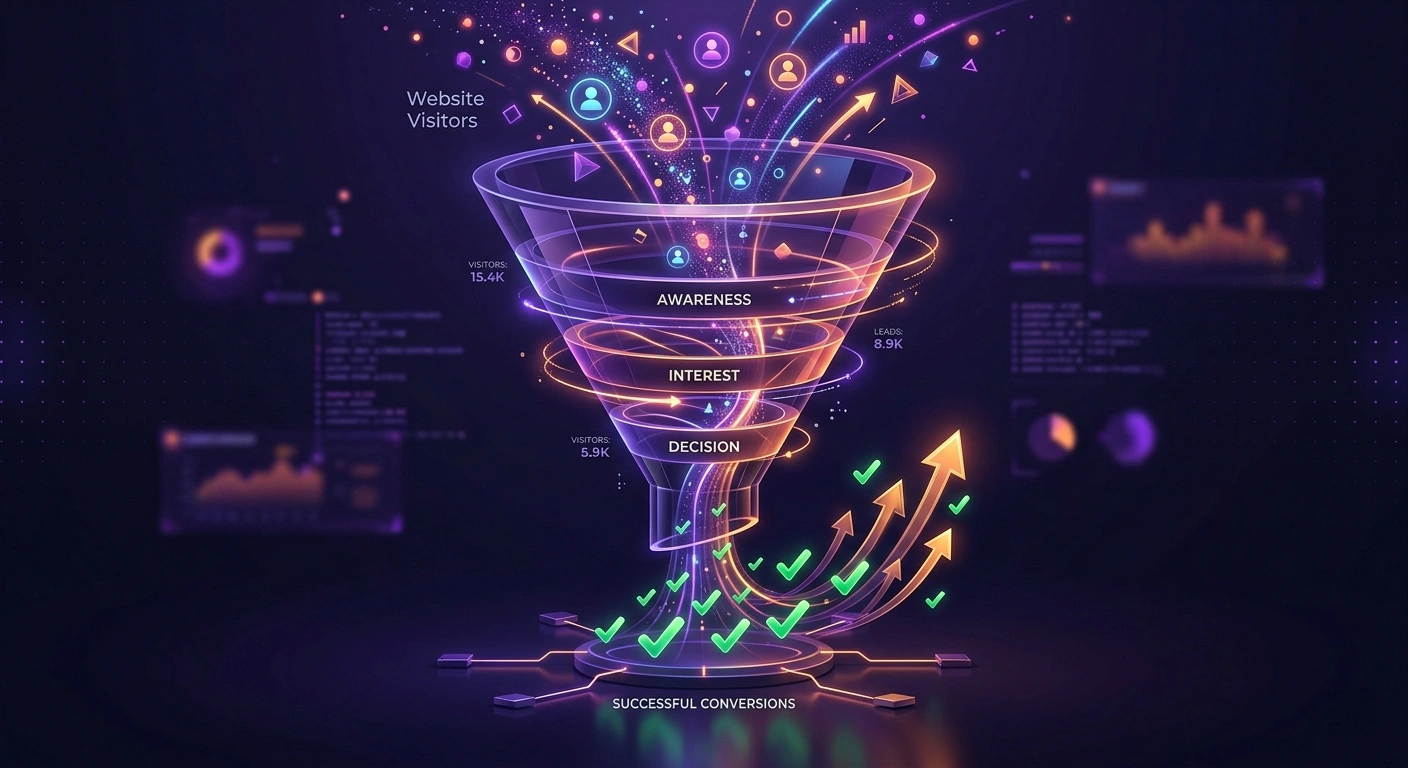
You ran the ads. You spent the budget. Traffic landed on your page — and then it disappeared. No form fills. No calls. No leads. Just a bounce rate that climbs every day while your cost-per-click stays exactly where it is. If this sounds familiar, the problem is almost certainly not your product, your offer, or your ad creative. The problem is your landing page.
A landing page is the single most critical piece of real estate in any paid or organic marketing campaign. It is where intent meets experience — and where the difference between a lead and a lost visitor is decided in under eight seconds. In this article, we break down the six most common conversion killers we see on landing pages across industries, and exactly what a properly engineered high-converting landing page does instead.
What a Landing Page Is Actually Supposed to Do
A landing page has exactly one job: convert a specific visitor with a specific intent into a specific action. That action might be filling out a form, booking a call, making a purchase, or downloading a resource. The critical word is "specific." Unlike a homepage — which serves multiple audiences with multiple goals — a landing page should be ruthlessly focused on one audience, one message, and one call to action.
The moment a landing page tries to do more than one thing, it starts doing none of them well. Visitors who land with a specific intent — driven there by a Google ad, a social campaign, or a targeted email — are looking for instant confirmation that they are in the right place. Any confusion, any distraction, any misalignment between what the ad promised and what the page delivers, and they are gone. You paid for that click. The page just wasted it.
A landing page is not a brochure. It is a handshake — a moment of precise, personalised communication between your offer and the exact visitor you targeted. Every element either earns that visitor's trust or loses it.
Peak Web Craft — Landing Page Strategy, 2026
The 6 Conversion Killers Destroying Your Landing Page Results
After building and auditing landing pages for businesses across India and globally, these are the six mistakes that appear most consistently on underperforming pages. Each one is fixable — but each one is also costing you real money every day it remains.
Killer 1: Message Mismatch Between Ad and Page
If your Google ad promises "Free Website Audit for Indian Businesses" and your landing page opens with a generic headline about your agency's services, you have broken what conversion specialists call message match. The visitor clicked your ad because of a specific promise. When that promise is not immediately confirmed on the page — using the same language, the same offer, the same framing — they assume they have landed in the wrong place. The fix is simple: mirror your ad headline in your page headline, and carry the core offer language through every section of the page without dilution.
Killer 2: A Weak or Absent Value Proposition
Most landing page headlines describe what a company does. High-converting landing pages communicate what the visitor gains. "We Build Business Websites" is a description. "Get a Website That Ranks on Google and Converts Visitors Into Enquiries — Built in 4 Weeks" is a value proposition. The difference is everything. A strong value proposition tells your visitor what they will get, how quickly, and why your version is worth their attention over every other option they could have clicked. If your headline does not answer all three of those questions, it is not doing its job.
Killer 3: Too Many Calls to Action
A landing page with three CTAs — "Book a Call," "View Our Work," and "Learn More" — is a landing page with no CTA. When visitors are given multiple options, they experience decision paralysis and frequently choose none of them. Every landing page should have a single primary CTA, repeated consistently throughout the page at natural decision moments. That CTA should be specific, benefit-driven, and low-friction: "Get My Free Audit" outperforms "Submit," and "Book a 20-Minute Call" outperforms "Contact Us" by a measurable margin in every A/B test run across comparable audiences.
Killer 4: No Social Proof Above the Fold
Trust is the primary barrier between a visitor and a conversion. Visitors who have never heard of your business arrive at your landing page with a default level of scepticism — particularly in India, where online fraud and disappointment with digital purchases has made consumers more cautious than ever. Social proof — client testimonials, recognisable brand logos, case study results, or a specific outcome metric — needs to appear in the first visible section of your page, not buried at the bottom. If a visitor does not see evidence that others have trusted you and benefited from it before they reach your CTA, the conversion rate will reflect that absence.
Killer 5: Form Fields That Feel Like an Interrogation
Every field you add to a form reduces the probability that it will be submitted. This is not an opinion — it is one of the most consistent findings in conversion rate optimisation research. The optimal number of fields for a top-of-funnel landing page is three to five: name, email, phone (optional), and one qualifying question such as project type or budget range. Asking for company size, years in business, annual revenue, and a detailed project description before you have established any relationship with the visitor creates friction that kills conversions. Collect more information on the call, not on the form.
Killer 6: Mobile Experience That Breaks the Flow
In India, over 70% of web traffic arrives via mobile devices. A landing page designed for desktop and squeezed into a mobile viewport is not a mobile landing page — it is a desktop page that happens to load on a phone. True mobile optimisation means rethinking the hierarchy of information for a vertical screen, ensuring the CTA button is tappable with a thumb without zooming, and confirming that the form fields activate the correct keyboard type on iOS and Android. Every landing page we build is designed mobile-first and tested across real devices before it ever goes live.
Pro Tip: Run your landing page URL through Google's PageSpeed Insights right now. A mobile score below 70 means Google is actively reducing your ad Quality Score — which means you are paying more per click for the same traffic your competitors with faster pages get at a lower cost. Speed is not just a UX problem; it is a paid media cost problem.
What a High-Converting Landing Page Actually Looks Like
Understanding what to avoid is only half the equation. Here is the structure we use as the foundation for every high-converting landing page we build at Peak Web Craft — tested across lead generation, service bookings, and e-commerce campaigns in the Indian market.
- Hero section with matched headline and a single CTA. The first section confirms the visitor's intent, communicates the core value proposition, and presents one clear next step. No navigation menu, no competing links, no distractions.
- Problem statement that validates the visitor's pain. Before presenting your solution, briefly articulate the problem in the visitor's own language. When people feel understood, they trust the solution far more readily.
- Solution section with specificity. Not "we help you grow," but "we build a landing page that loads in under 2 seconds, passes Core Web Vitals, and is structured around a single conversion goal." Specific claims are credible. Vague claims are invisible.
- Social proof with specificity. Not "clients love us," but "Rahul's coaching business went from 3 enquiries a month to 27 in the first 60 days after the new landing page launched." Named results beat anonymous praise every time.
- Objection handling built into the copy. Every visitor who reaches your CTA has a reason not to click. Price, time, trust, and relevance are the four most common objections. Address them directly in the copy before they surface as a reason to leave.
- A final CTA with urgency or a risk reversal. "Book a Free 30-Minute Strategy Call — No Commitment Required" is more persuasive than "Contact Us" because it removes the perceived risk of clicking and defines exactly what happens next.
Landing Page vs Website: Which One Do You Actually Need?
One of the most common questions we get from clients running paid campaigns is whether they should be sending traffic to their homepage or to a dedicated landing page. The answer is almost always a dedicated landing page — and here is why.
Your homepage is designed to introduce your entire business to a cold visitor who may have arrived from any number of different contexts. It has multiple navigation options, multiple sections covering multiple services, and multiple possible next steps. This is appropriate for organic visitors exploring your brand. It is a conversion disaster for paid traffic with a specific intent.
A dedicated landing page removes every element of your homepage that is not directly relevant to the campaign's goal. No navigation menu to escape through. No unrelated service sections. No blog links, footer links, or social media icons pulling attention away from the single action you paid to create. The research is consistent: removing navigation from a landing page alone can increase conversion rates by 10 to 30 percent, depending on the audience and offer.
Pro Tip: If you are running more than one campaign — say, one targeting wedding photographers and another targeting corporate clients — build a separate landing page for each. Personalised pages that speak directly to a specific audience's problem consistently outperform generic pages that try to appeal to everyone.
How to Audit Your Current Landing Page in 10 Minutes
Before investing in a rebuild, run this quick audit on your existing landing page. It will reveal exactly where your conversion flow is breaking down.
- Read your headline aloud. Does it immediately communicate what the visitor gets and why it is worth their time? If it sounds like a tagline rather than a promise, it is costing you conversions.
- Count your CTAs. If there are more than one type of action visible above the fold, you have too many. Remove everything that is not the primary conversion goal.
- Check message match. Open your ad in one tab and your landing page in another. Does the headline language align closely? Could a visitor tell immediately that the page is a direct continuation of the ad?
- Test the form on your phone. Fill it in completely using only your thumb. Time how long it takes. If it takes more than 60 seconds or requires zooming at any point, your mobile form UX is a conversion leak.
- Look for trust signals above the fold. Is there any social proof visible before the visitor scrolls? If not, add a client logo strip, a single powerful testimonial, or a specific outcome metric immediately below your headline.
Wrapping Up
A landing page that does not convert is not a marketing problem — it is a revenue problem. Every day your current page sits live with a conversion rate below its potential, you are paying for traffic that is generating nothing in return. The six conversion killers in this article are not rare edge cases. They appear on the majority of landing pages we audit, and they are directly responsible for the gap between the traffic numbers and the lead numbers that leave most business owners confused.
At Peak Web Craft, our Landing Page service is engineered around a single outcome: turning your traffic into qualified leads. We combine conversion-focused copywriting architecture, mobile-first design, and technical performance optimisation to build pages that do the job they were paid to do. If your current landing page is falling short, let's start a conversation. We typically respond within 24 hours.